

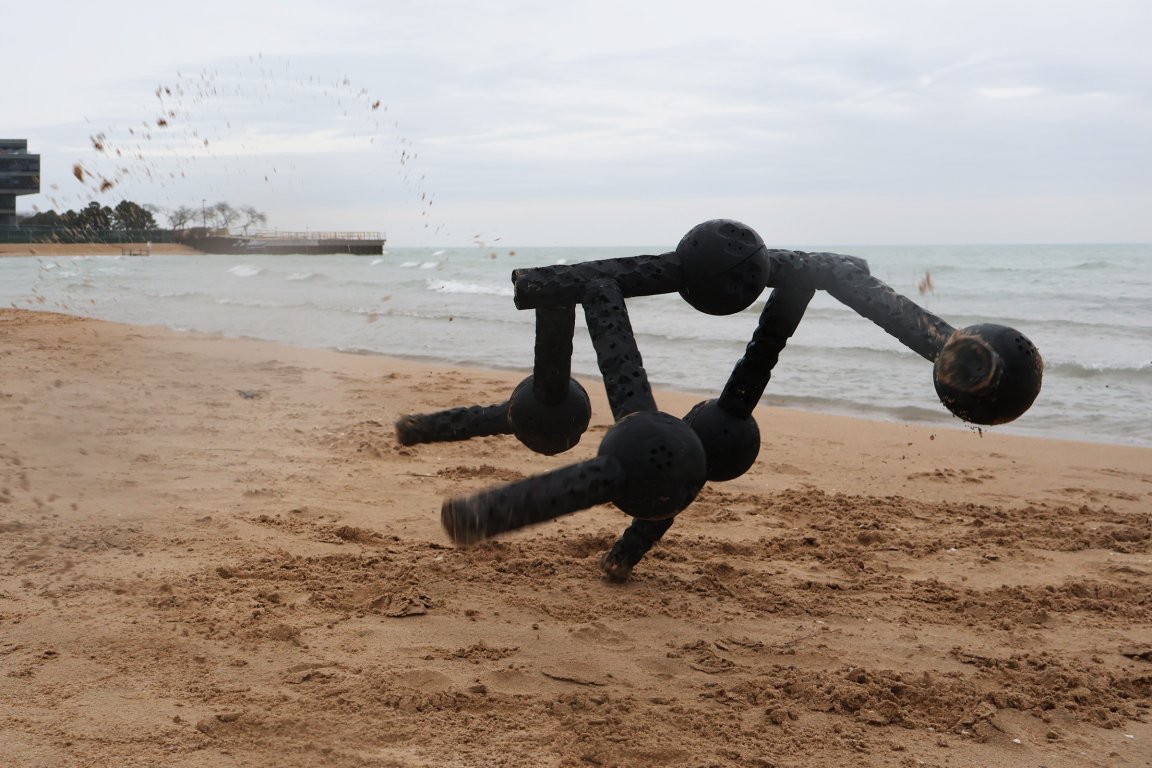
The future of robotics may not lie in the clunky androids we’ve been seeing so many of lately, but instead in strange, arachnoid conglomerations of sticks that writhe their way across landscapes.
These so-called “metamachines” kind of look like if you made giant caltrops out of Magnetix and then zapped them with the gift of movement. They might sound cute, except that their creators say that their AI algorithm-inspired designs lets them keep persevering even after losing parts of themselves, like a limb that gets hacked off from a horror movie’s killer robot.
In footage of the metamachine’s exploits, a researcher bludgeons one with a heavy stick that cuts off its rear half. This would immobilize or maybe even brick a robodog or a humanoid machine. Even so, the thrashing robot continues to crawl forward, unbothered.
Their hardy nature is thanks to their modular design, wherein each of the robot’s leggy protrusions, each half a meter long, are themselves their own robots, connecting to each other with spherical elbow joints. In theory, this makes them incredibly versatile, capable of reconfiguring their forms to navigate tricky environments.
“We’re making robots that are made of robots, which is why I call them metamachines,” Sam Kriegman, a roboticist at Northwestern University and coauthor of a new study published in the Proceedings of the National Academy of Sciences, told Reuters in an interview.
“If one part of the body is damaged or lost to injury, the rest of the body is fine,” Kriegman added. “It survives. It continues to function.”
The researchers liken their design to a new “species” of machines, with chameleon-esque adaptability. Continuing the animal analogies, a university release characterizes the metamachines as able to “undulate like seals, bound like lizards, or spring like kangaroos.” (Outwardly, the appearance is more like an abortive spider.) And besting many beetles, the robots can “instinctively” flip themselves upright if they’re turned over, and even show off with acrobatics like pirouetting in the air.
“We really wanted to create robots that were more resilient and that could evolve,” Kriegman said. “We evolved these robots to move themselves through the world with a little bit of athleticism, so more athletic than any other modular robot has been on land. More athletic than any other evolved robot has been.”
It’s not the only research exploring modular robots. A team from Columbia University developed a prototype robot platform called a “Truss Link” that can similarly combine with each other to form a larger unit capable of crawling and even climbing up obstacles. At NASA, engineers have designed a snake-like robot to plunge into the vents on the surface of Saturn’s moon Enceladus. These unorthodox designs suggests that there may be useful alternatives out there to the typical bipedal and quadrupedal designs that dominate the public’s imagination.
More on robots: There’s Something Incredibly Weird About Two Delivery Robots Crashing Through Glass Bus Shelter in Chicago Within a Few Days of Each Other