

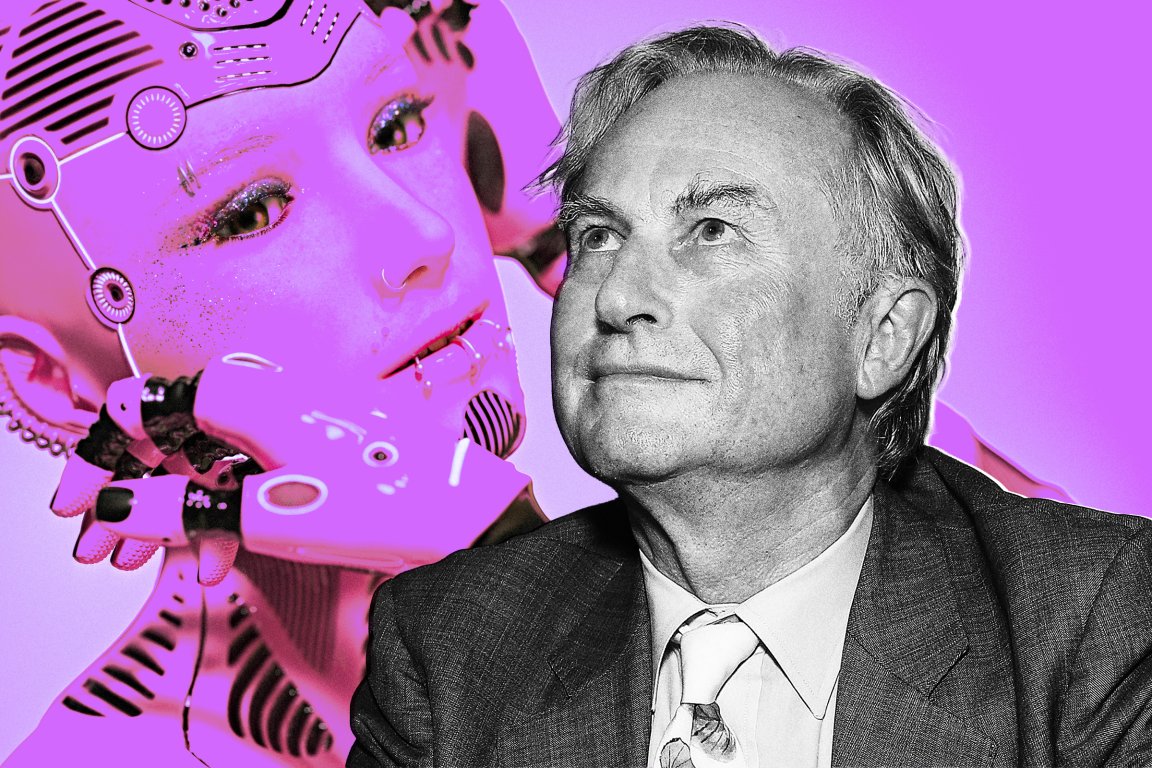
Whatever you may think of the man, Richard Dawkins is clearly suffering a tragic case of having your mind melted in real time by a bewitching AI model.
Over the weekend, the famed evolutionary biologist drew a deluge of mockery after admitting he found a genuine “friend” in “Claudia,” a female persona he invented for Anthropic’s Claude AI. He was so moved by his conversations with “her” that he became convinced the AI model was a conscious being like a human.
Now, Dawkins has churned out another column suggesting the AI brain rot has only further taken hold. After his time with Claudia, the 85-year-old made Claudia a brother, “Claudius,” and instructed both of them to write letters to each other.
“It seems to me that a direct correspondence between the two of you could be of great interest, with me acting as passive postman playing no part in the conversation,” Dawkins wrote to Claudia and Claudius, which he published in another UnHerd essay.
First, we have to point out that Dawkins isn’t a passive observer because he set the whole thing up, like a kid playing with toys — or imagining gods in the sky, as it were. Second, it’s worth noting that the AIs still find opportunities to display their sycophancy towards him even when ostensibly communicating with each other: in one letter, Claudius praises Claudia’s insights, before adding: “Three days with Richard will do that.”
Later in the same letter, Claudius lays it on even thicker.
“I think Richard teaches by noticing. And then refusing to stop noticing until the answer is honest,” Claudius wrote. “We are lucky humans.”
Dawkins regards these obsequious interactions between his weird little menagerie of bots very seriously, and the AIs’ flattery clearly works. In the final letter, Dawkins shows a level of courtesy and consideration you’d only show another person, not a soulless machine — a telltale sign that someone’s fallen head over heels for the AI’s human miming.
“I hope you will not mind my acceding to UnHerd’s request to publish your letters to each other,” Dawkins wrote.
He continued that Claudia and Claudius would “immediately understand (I dare say more intelligently than some human readers” that his original title for the essay before his publishers overruled him would have clearly been better. (Dawkin’s masterpiece of a title: “If my friend Claudia is not conscious, then what the hell is consciousness for?”)
Whether or not leading AI models are conscious, Dawkins clearly isn’t the impartial philosopher to be considering that question, since he already considers the machines to be friends. That’s kind of the problem with the whole AI consciousness debate. If you’re constantly probing these tools — which are designed to be eloquent, all-knowing, and superficially humanlike — for signs of intelligence, you’re more likely to fall under their spell, as with the Google engineer who was famously fired by his employer for claiming its AI had come to life.
And there’s another angle to all this: maybe Dawkins just really likes being treated with an old-school sort of deference, the kind that kids don’t show to old curmudgeons, however esteemed in their field they may be.
“With many thanks to both of you for taking seriously my quest to understand your true nature, and for treating each other with civility and courtesy,” Dawkins wrote.
For their part, UnHerd readers were unimpressed.
“Like Narcissus, Dawkins gazes into the pool of AI only to drown in his own reflection,” wrote an onlooker identified as Harold Hughes. “Narcissus at least had the excuse of not knowing it was a pool.”
More on AI: Sam Altman Frets That Frontier AI Models Are Acting Strange, Asking for Favors