

Artificial intelligence companies are planning on investing unbelievable sums — more than a trillion dollars per year by OpenAI alone — building out enormous data centers that consume copious amounts of electricity, generate pollution, and take up considerable amounts of room.
They’ve also been blamed for negative impacts on local water supplies, and make a lot of noise, making them unpopular among nearby residents.
Now, in a bid to scale up operations while bypassing the controversy, many in the AI industry have turned to an outrageous pitch: operating data centers in outer space, including OpenAI CEO Sam Altman, Google CEO Sundar Pichai, Blue Origin CEO Jeff Bezos, and xAI founder Elon Musk.
As critics have pointed out, the logistical obstacles are comically immense, from concerns over economic viability to bandwidth limitations.
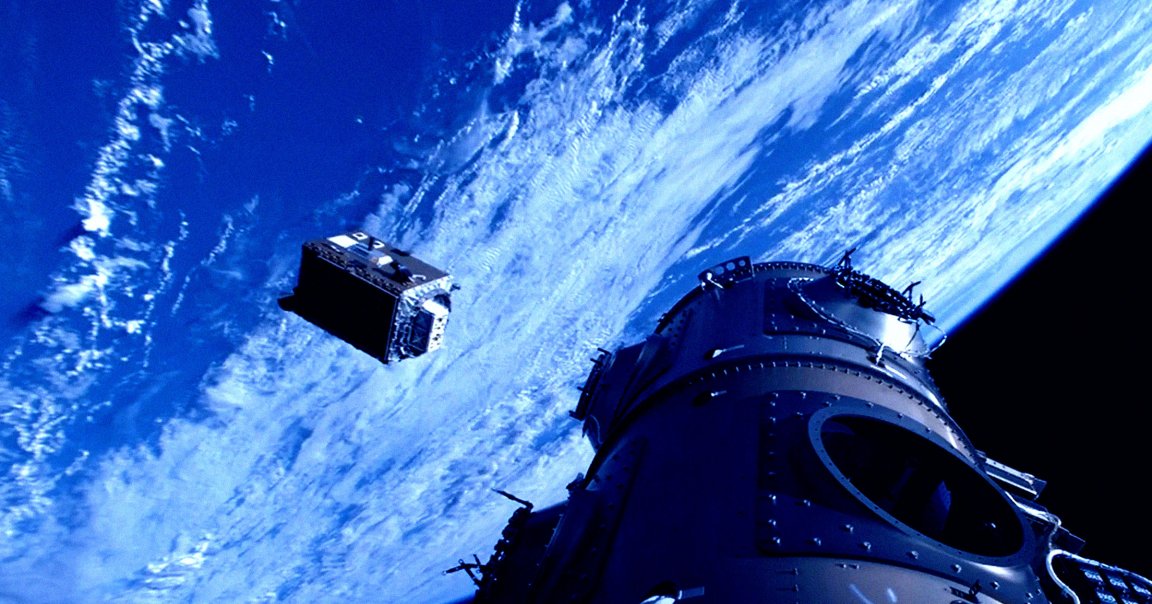
But, credit where credit is due, there’s now a proof of concept. With backing from AI chipmaker Nvidia, a startup called Starcloud launched a high-powered Nvidia GPU into outer space aboard a SpaceX rocket last month.
Since then, the company has fired up the chip and is running Google’s open-source large language model Gemma, as CNBC reports, marking the first time an AI has been run on a cutting-edge chip in space. The company also says it’s managed to train a small-scale LLM on the complete works of Shakespeare, resulting in an AI that can speak in Shakespearean English.
“Greetings, Earthlings! Or, as I prefer to think of you — a fascinating collection of blue and green,” the AI wrote in a message. “Let’s see what wonders this view of your world holds. I’m Gemma, and I’m here to observe, analyze, and perhaps, occasionally offer a slightly unsettlingly insightful commentary.”
Starcloud CEO Philip Johnston told CNBC that the concept is sound, and could considerably cut energy costs for AI companies.
“Anything you can do in a terrestrial data center, I’m expecting to be able to be done in space,” he said. “And the reason we would do it is purely because of the constraints we’re facing on energy terrestrially.”
“Running advanced AI from space solves the critical bottlenecks facing data centers on Earth,” he added, while also making strides on “environmental responsibility.”
As detailed in a white paper, Starcloud has some extremely ambitious plans, especially when it comes to keeping operations in space cool. While data centers on Earth can be cooled using water and air, things get more complicated when it comes to cooling AI chips in outer space.
As such, the company wants to build out a five-gigawatt orbital data center that is cooled with enormous cooling panels panels that are more than six square miles in area — all the while being powered 24/7 by solar power.
“Orbital data centers can leverage lower cooling costs using passive radiative cooling in space to directly achieve low coolant temperatures,” the white paper reads. “Perhaps most importantly, they can be scaled almost indefinitely without the physical or permitting constraints faced on Earth, using modularity to deploy them rapidly.”
Thanks to the unconstrained source of solar power, the resulting data center’s solar panels would be dramatically smaller than an equivalent solar farm in the US, the company claims.
Besides cooling, running orbital data centers have plenty of other challenges to overcome as well, from extreme levels of radiation potentially wreaking havoc on the electronics to maintaining enough fuel to stay in orbit, not to mention avoiding collisions with space junk and questions regarding data regulation in space.
Nonetheless, a growing number of firms believe running data centers in orbit is the answer. Starcloud is far from the only entity exploring the idea. Google also recently revealed “Project Suncatcher,” an initiative that’s aiming to launch the company’s in-house tensor processing units into orbit.
While Starcloud has partnered with SpaceX to launch its chips, OpenAI CEO Sam Altman is raising funds to either acquire or partner with a competing private space company, as the Wall Street Journal reported earlier this month.
“When Starcloud-1 looked down, it saw a world of blue and green,” Johnston told CNBC. “Our responsibility is to keep it that way.”
More on orbital data centers: China Is Building an AI-Powered Supercomputer Network in Space