

Earlier this month, we published a months-long investigation into a little-known company called Brown Brothers Media. The venture is run by three brothers — Justin Brown, Lachlan Brown, and Brendan Brown — who buy struggling online publications and turn them into AI-powered slop farms that post thousands of articles to scoop up massive traffic from platforms like Google, pushing unwitting readers away from real journalism in the process.
The growth of the Brown brothers’ empire, we found, has been powered by extraordinary acts of dishonesty and manipulation. As it fired virtually all its writing staff after the release of ChatGPT, it created scores of fake reporters, subject matter experts, and relatable everyday characters, then used their bylines to pump out lazy AI articles that were often plagiarized from original journalism, based on completely made-up “personal experiences,” or so careless and flawed that it’s hard to believe anyone at the company even reads them before they’re published.
It appears that the operation has been a resounding success. According to data we reviewed, Brown Brothers Media’s network of sites is estimated to pull in somewhere around 64 million visits per month. That’s an astounding amount of traffic, putting the Brown brothers in a league with large media organizations like NPR or the Washington Post — and making them a stunted yet fascinating new type of media power player in the AI slop era.
After we ran the story, we were surprised to learn a further fact about the Brown brothers that casts their activities with AI and the media in a peculiar new light: a startup Justin Brown founded called Ideapod, which was later folded into Brown Brothers Media and is still operating today, had numerous connections to the orbit of deceased financier Jeffrey Epstein — and particularly his longtime associate Ghislaine Maxwell, who is currently serving 20 years in federal prison for a sex trafficking conviction stemming from her work procuring underage girls for the infamous predator.
In response to detailed questions about this story, Justin strongly pushed back against any association with Epstein.
“I had no relationship, contact or dealings whatsoever with Jeffrey Epstein,” he wrote via email. “I never met or communicated with Epstein, had any business, financial, social or other dealings with him, received funding from him, or visited his island. Ideapod never received funding or investment from Epstein.”
On the subject of Maxwell, he was more circumspect.
“I am not prepared to speculate from memory or provide a question-by-question reconstruction of thirteen-year-old business and social history,” he wrote. “Any statement or implication that I or Ideapod had a relationship with Epstein, received funding from him, or knew about or participated in the crimes of Epstein or Ghislaine Maxwell would be false.”
***
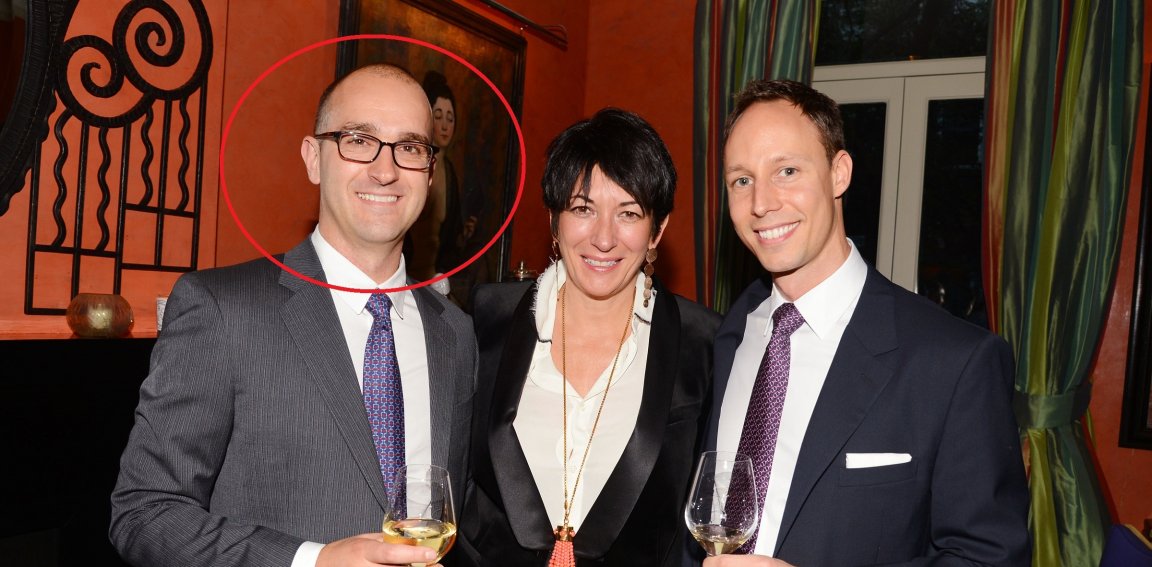
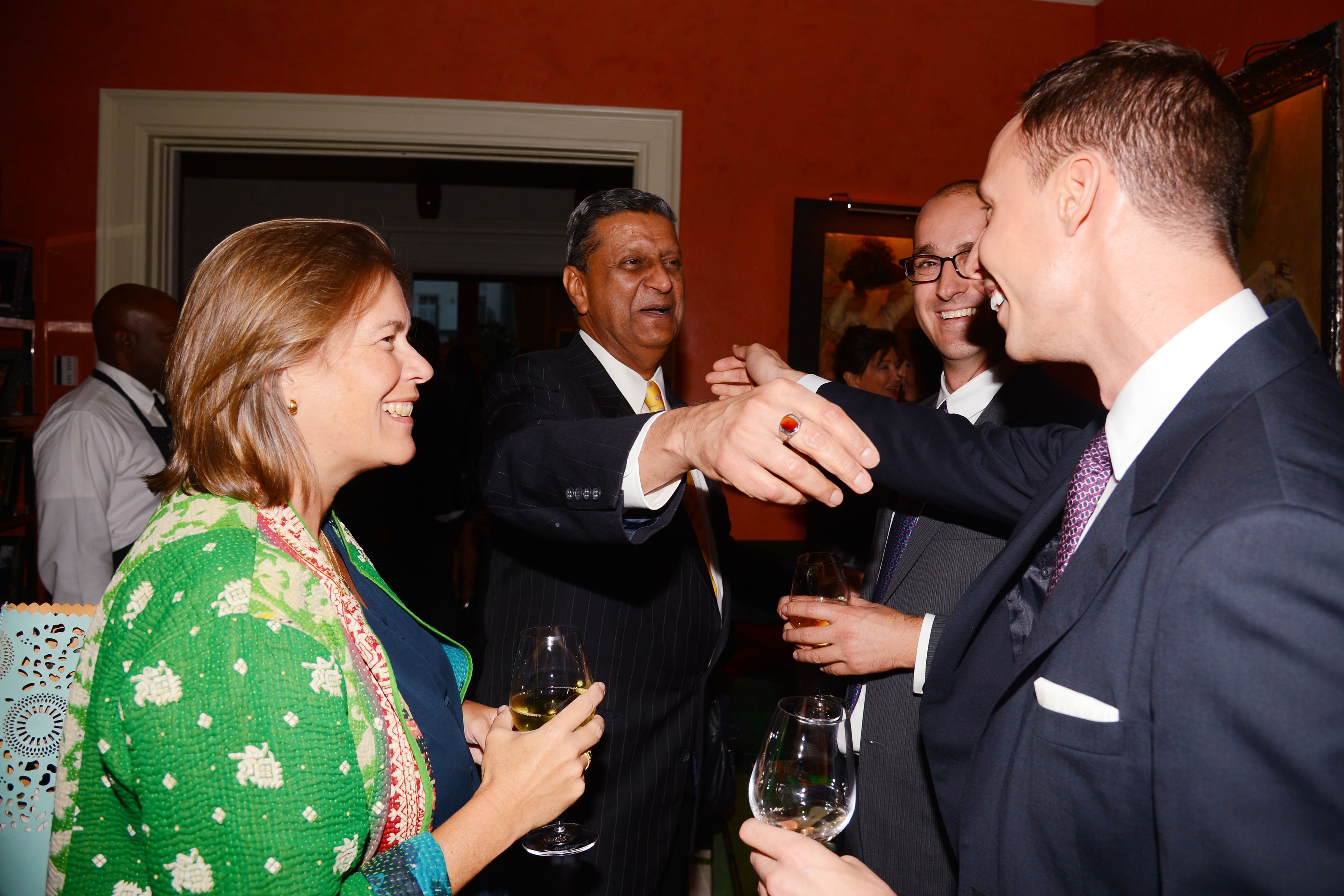
Back in September 2013, according to a cache of photos available on Getty Images, Justin Brown was a guest of honor at a “cocktail reception” thrown by Maxwell at her multimillion-dollar Upper East Side Manhattan townhouse, which Epstein purchased for her in the year 2000.
In the photos, Justin can be seen posing and chatting with the socialite and future convicted child sex trafficker, dressed in a gray suit and holding a wine glass. (The event was billed as being hosted by “Dom Pérignon & Ghislaine Maxwell”; LVMH, the luxury goods conglomerate that owns the vintage Champagne brand, didn’t respond to a request for comment.)
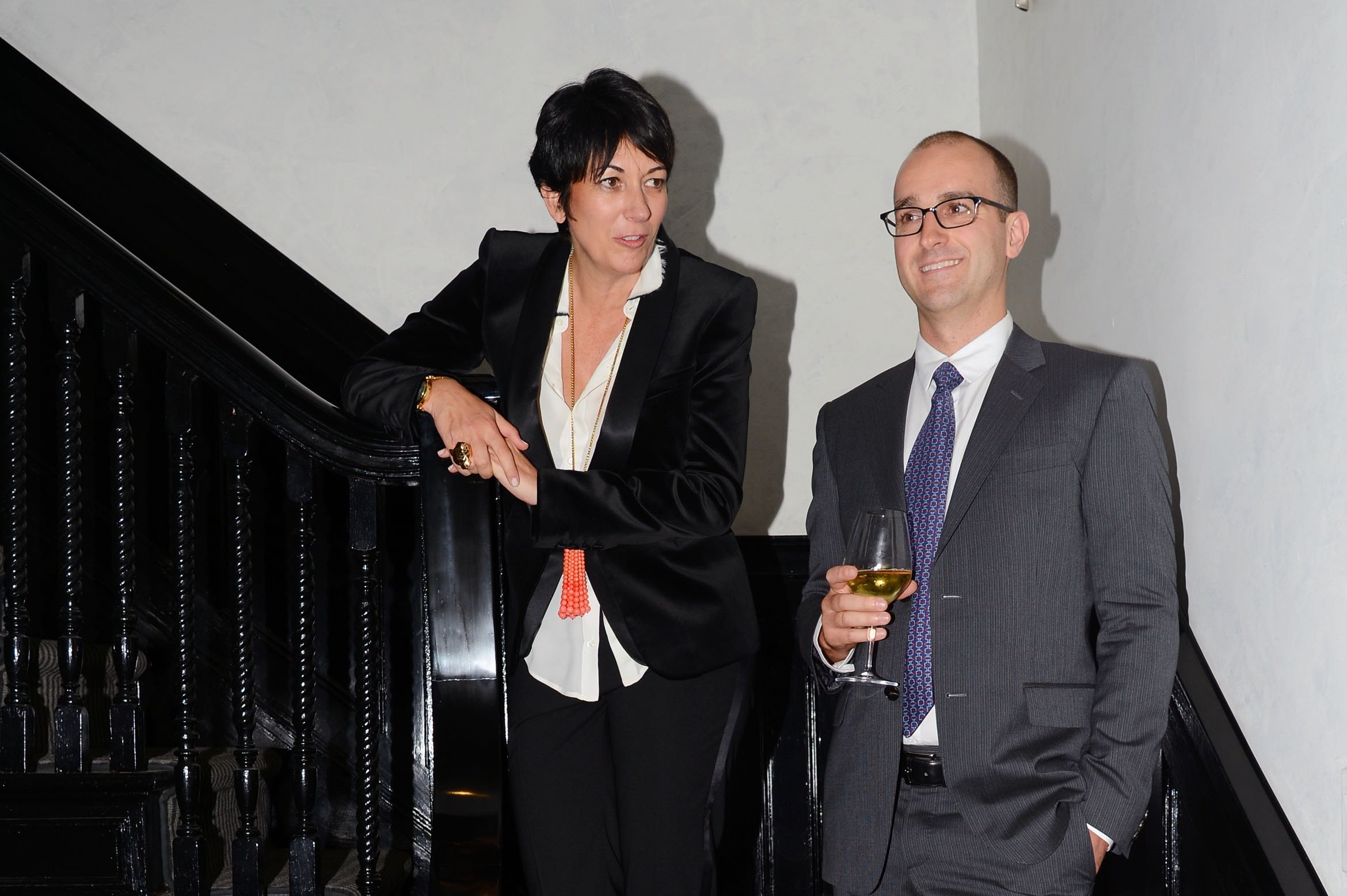
Justin showed up to the party years after Epstein’s original 2008 conviction for soliciting girls as young as 14. At the time, Epstein had been released from prison and put on the sex offender registry. It was easy to Google news articles about his plea deal and his close relationship with Maxwell that dated back to the early 1990s.
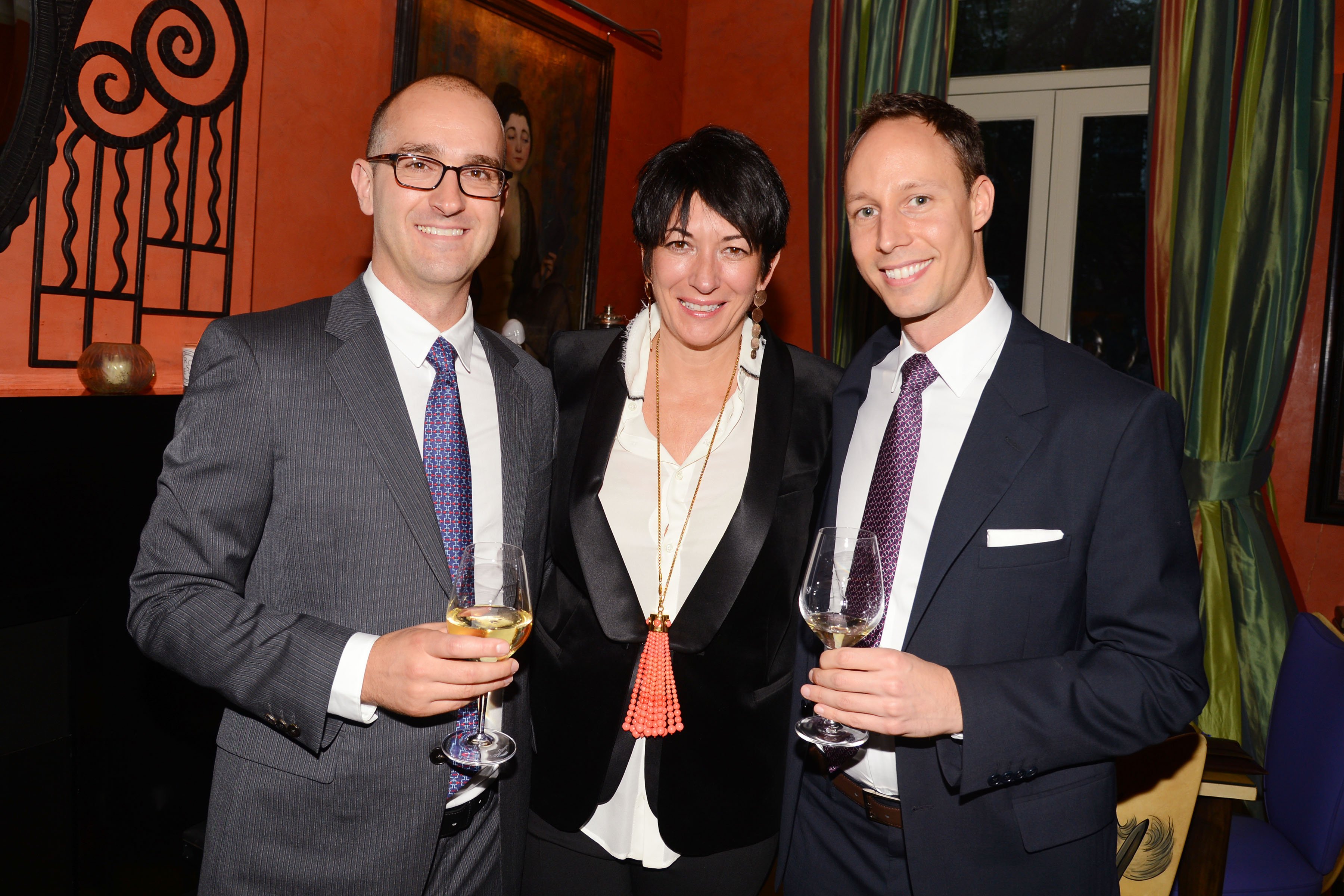
Maxwell had thrown the soirée to celebrate the launch of Ideapod, a social media company started by Justin that billed itself as promoting “positive change by allowing everyone to share powerful ideas with the world’s most influential organizations and thought leaders.” Justin and his cofounder, Mark Bakacs — also at the 2013 party, as pictured below, and who Justin described in a 2015 article for Inc as his “best friend from high school” — positioned Ideapod as a more enlightened competitor to other social media platforms like Facebook and Twitter.
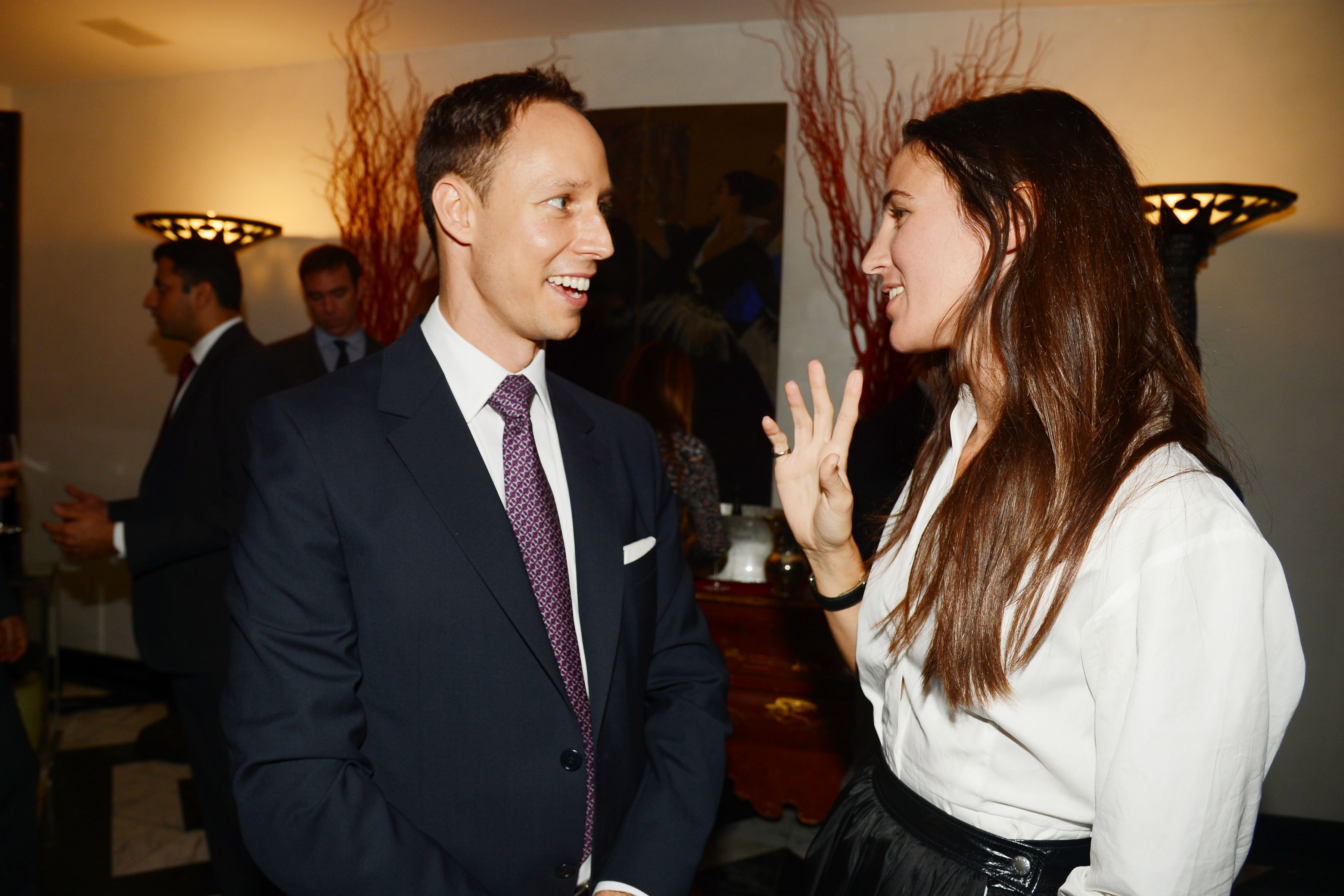
Another guest at the 2013 party was Katherine Keating, the daughter of the former Prime Minister of Australia Paul Keating. Like Maxwell, Keating was connected to Epstein. After Epstein’s 2019 arrest, unearthed video from 2010 appeared to show Keating at Epstein’s Manhattan home with Andrew Mountbatten-Windsor, then known as Prince Andrew, one of Epstein’s most notorious associates whose royal title was later stripped as the scandal deepened. Then, documents published in 2025 by the US Department of Justice revealed Keating exchanging friendly emails with Epstein and his staff to coordinate several meetings, with Keating at one point offering to bring her younger sister to lunch with Epstein and Woody Allen after she was told that the director — who’s faced his own child sex abuse allegations — liked “pretty women.”
Keating was also involved with Ideapod. She was listed as part of the company’s team on an archived page from the startup’s site back around the time of Maxwell’s fête, and a few months later she announced a “series of 52 five-minute interviews” for the Huffington Post, set to be published by Global Grind — a hip hop site by Def Jam cofounder Russell Simmons, who later resigned after a storm of sexual assault allegations — and Ideapod. Photos from the party show her conversing with Justin and Bakacs.
“I want the philosopher with the musician with the rapper with the director,” Keating said of the Ideapod collaboration. “That’s the only way it’s going to stay relevant… Young people might not want to hear what George Soros has to say, but if you couple him with Lady Gaga.”
Also mingling at the Ideapod launch was Amir Dossal, a former United Nations official who served on the board of Maxwell’s environmental charity, the TerraMar Project, which reportedly raised $283,429 — and owed Maxwell $549,093 in loan repayments — while giving out just $874 in grants. Amid reporting in 2019 that it was facing an investigation by the FBI over whether it was linked to Epstein’s sex trafficking operation, TerraMar abruptly shut down.
Dossal was also associated with Ideapod, serving as an advisor for the venture. (Dossal didn’t respond to a request for comment.)
“Ideapod is a great place to exchange ideas and learn about other people’s views in a relaxed environment — without the ‘noise,'” Dossal later wrote in a testimonial for the startup. “I find it very refreshing to see so many great ideas and initiatives from across the world — with many brilliant suggestions for bringing about positive social change.”
Several more TerraMar board members were at the party. Photos show Ariadne Calvo-Platero, the daughter of the British Lord Beaumont of Whitley and reportedly Maxwell’s “best friend” as of 2011, whose name appears in Epstein’s notorious “little black book”; Steven Haft, a lawyer and executive connected to cryptocurrencies and media who produced movies including “Dead Poets Society”; and Stuart Beck, a former UN ambassador for the Pacific island nation of Palau who passed away in 2016. One shot from the gathering at Maxwell’s house shows Calvo-Platero, Dossal, Justin, and Bakacs all socializing together. (Neither Calvo-Platero nor Haft responded to requests for comment.)
***
Content from Ideapod’s site around the time of its launch has long been deleted, and is only sporadically backed up by the Internet Archive.
One page that appeared on its site in advance of Maxwell’s launch party promoted an initiative called “APYouthNet,” which purported to “bring together people who share a passion for the subject of youth employment.” Another post, credited to “UNESCO [United Nations Educational, Scientific and Cultural Organization] Bangkok,” promoted an initiative with the Thai Ministry of Education to “support youth, especially non-formal education students to obtain life skills.” (UNESCO Bangkok didn’t respond to a request for comment.)
In the wake of the September party, Justin repeatedly promoted Maxwell and her endeavors on social media.
In December 2013, he shared Maxwell’s TED Talk from earlier that year— titled “Sea Hope, Sea Change, Sea Future” — on Twitter, tagging TerraMar. Then in February 2014, he tweeted that he’d “just taken the I Love the Ocean pledge at the TerraMar Project.”
Days later, he shared an Ideapod page titled “Know Much More About Ghislaine Maxwell” — it’s since been deleted, and no archived version seems to exist — and again tagged TerraMar. He continued to post about TerraMar throughout the evening, at one point sharing a photo of Maxwell seated in a room at the UN.
“Ghislaine Maxwell of [the TerraMar Project] being graciously introduced by [Amir Dossal],” Justin wrote. “Two wonderful activists. cc [Ideapod.]”
A YouTube video published by TerraMar shows Dossal introducing Maxwell at the event, along with Haft and Beck, the other TerraMar guests from Maxwell’s Ideapod party.
“I’m now going to invite the person who has been the inspiration behind the Sustainable Oceans Alliance, who really has something called TerraMar Project,” Dossal tells the room. “She controls the oceans around the world. If you were to look at the website you have the opportunity to buy up parts of the ocean through her… I invite my dear friend, Ghislaine Maxwell, to tell us how we can own the oceans.”
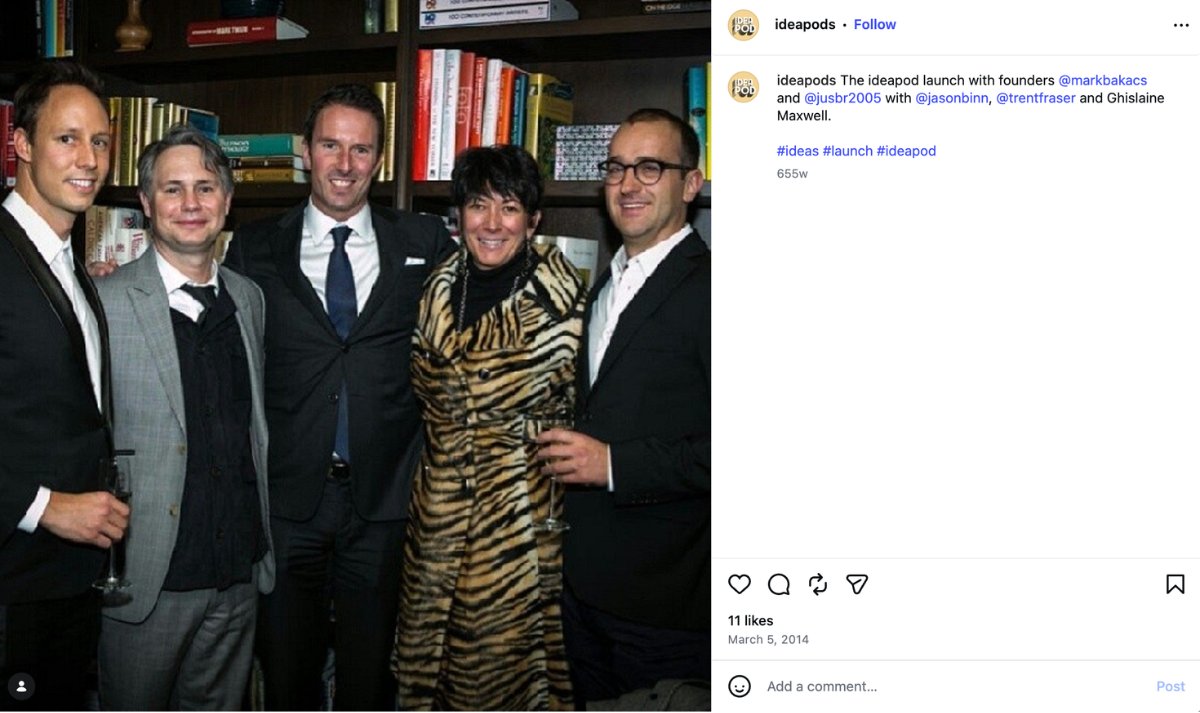
Justin and Ideapod kept hanging out with Maxwell in the real world. In March 2014, Ideapod’s Instagram posted a photo from another party where the future convicted sex trafficker made an appearance, smiling in a photo with the company’s founders while wearing a tiger print coat. The shot was captured at what was then Ideapod’s New York office, another guest in attendance told Futurism. A second photo posted by the startup showed Bakacs and Justin smiling and laughing with Keating.
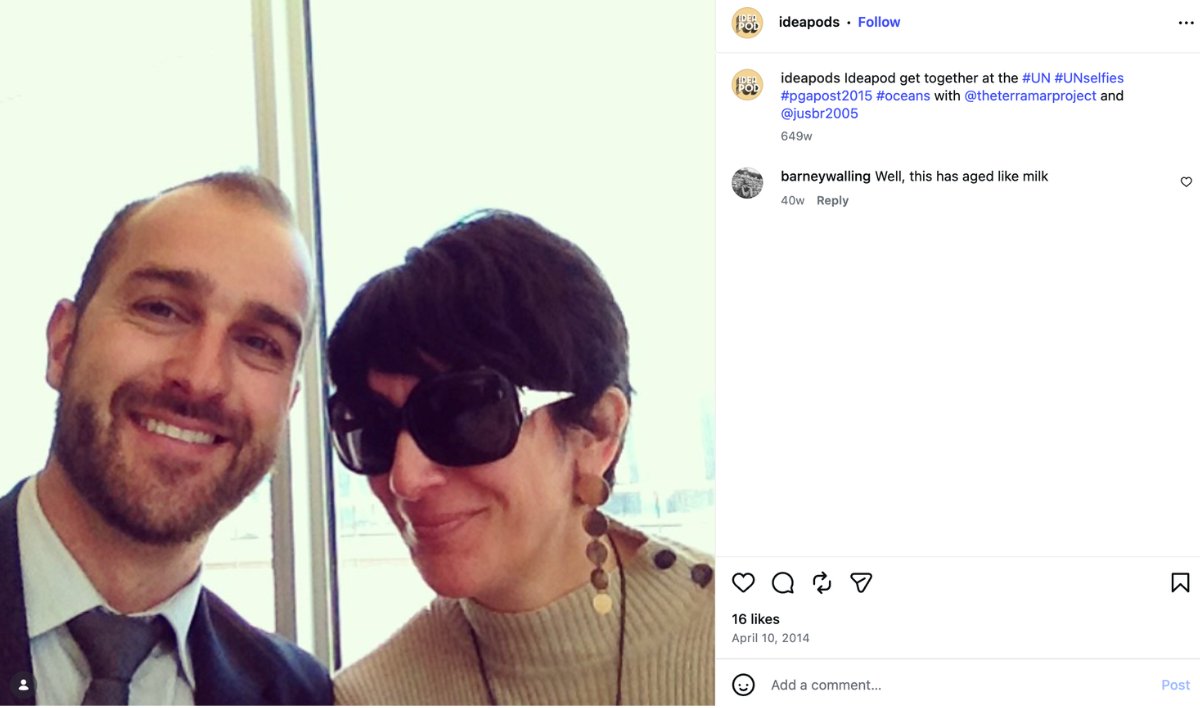
The next month, in April, Ideapod posted a grinning selfie of Justin and Maxwell on its Instagram. Maxwell is pictured smiling softly, her eyes shielded behind huge sunglasses.
“Ideapod get together at the UN,” reads the caption, again tagging TerraMar. (“Well, this has aged like milk,” a commenter added years later.)
A few weeks after that, in May 2014, Maxwell appeared in an interview with Katherine Keating — the member of Ideapod’s team from the first party with links to Epstein and Andrew Mountbatten-Windsor — that was prominently branded as “in association with Ideapod.”
The interview was seemingly part of the collaboration Keating had referenced between Ideapod and the Huffington Post, where she was a contributing editor at the time and which published a version of the chat on its site. (The video also credited Francesco Carrozzini, an Italian photographer who was later romantically linked to the singer Lana Del Rey, and married to Bee Shaffer, the daughter of Anna Wintour.)
“Does my hair look good?” Maxwell says at the start of the clip, fussing with her signature pixie cut and laughing.
“If the ocean dies, I’m not sure what that outcome will be,” Maxwell tells Keating in the interview. “But definitely not good.”
“Continue the conversation at Ideapod,” reads a closing slide on the interview, along with a link to Ideapod’s site.

A spokesperson for the Huffington Post, which was later rebranded as HuffPost and purchased by BuzzFeed, downplayed the video, saying that Keating was never on staff or compensated for her work.
In a statement to Futurism, Keating said that the interview was sponsored by Ideapod and that Justin had introduced her to Maxwell.
“My only connection to Ideapod was its limited sponsorship of several episodes of an online interview series published on HuffPost,” she wrote. “I had no role in Ideapod as a business, have no knowledge of their business dealings and have had no contact with its founders since the sponsorship ended. For its September 2013 platform launch, Ideapod’s founders introduced me to Maxwell and asked me to interview her about TerraMar’s stated ocean-conservation work. The interview was to be screened at the launch event, which Maxwell hosted.”
“My dealings with Maxwell were limited to the interview and launch event,” she added. “I had no other dealings or ongoing relationship with her and, at that time, had no knowledge of her relationship with Epstein.”
We also reached out to Maxwell’s attorney with questions, but didn’t hear back.
***
Ideapod seemed to struggle to settle on a business model. Over the years, it vacillated between promoting a social network for people with big ideas, a search engine that never seems to have materialized, something called “Ideapod Academy,” and even a 16-week course by a Brazilian shaman named Rudá Iandê. It also held real-world “salons” where Ideapod users could meet and discuss ideas like virtual reality and the “role that inspiration can play in the human connection.”
There were soon signs that money was tight. In 2014, Ideapod launched a crowdfunding campaign on Indiegogo seeking backers — to support what it described as “Medium meets Twitter meets TED” — and ultimately raised only $53,613.
According to an Ideapod employee at the time, Justin emailed staff about approaching attendees at Maxwell’s party to let them “know we’re fundraising and that we’re looking for the right partner who believes in the vision.”
“Ghislaine has offered to continue hosting Ideapod events at her home and we’re exploring the best way to grow the community of early users,” Justin wrote in the message.
Also in 2014, Ideapod sought financing from another figure with longstanding relationships to Epstein and Maxwell: Richard Branson, the English founder of Virgin Group, who once emailed the convicted sex offender encouraging him to “bring your harem!” to a meeting. Branson is also a figure from the TerraMar universe; he was named a “founding citizen” of the project, according to The New York Times, and praised TerraMar in a since-deleted Facebook post. (A spokesperson for Branson told us that the mogul had no role in TerraMar.)
As Justin later wrote for Forbes, he and his cofounder Bakacs flew out to Necker Island, which is owned by Branson in the British Virgin Islands — about 34 miles as the crow flies from Epstein’s infamous private island of Little St. James, with the neighboring billionaires sometimes visiting each other — and which is famous for hosting invite-only retreats for entrepreneurs.
“We were low on cash and had difficulty even making it to the island,” Justin recalled in Forbes. “Conventional wisdom dictated that we conserve what we had left and continue with business as usual in New York. Instead, we furiously raised more funds, because we were convinced that Ideapod would receive a warm reception. And it did. We met four new investors and Branson wrote this blog post about us, making the trip a huge success.”
The blog post Justin linked to has since been deleted from Virgin’s site, but an archived version shows that in it, Branson enthused about Ideapod in strikingly vague terms, writing that the startup was “all about sharing ideas and collaborating on bringing them to life, which can only increase the chances of society coming up with more game changing concepts.” (The post was deleted when Virgin’s site was “replatformed in 2021,” Branson’s spokesperson told us.)
In a Facebook video posted from Branson’s island, Bakacs projects his voice over music playing loudly in the background to ask Branson if he has a message for the “Ideapod community.”
“I love Ideapod, and I loved reading about all the ideas that you came up with,” Branson says, sounding a little flustered. “In fact, I’m writing an article for the New York Times based on that.” (Branson does not appear to have published an article for the NYT that mentions Ideapod.)
Branson’s spokesperson told Futurism that the billionaire “met Ideapod’s founders at an event for entrepreneurs hosted by a third-party, where Richard was invited to speak.” After meeting Justin and Bakacs, the spokesperson added, Branson was “offered the opportunity to take a stake in the business but did not invest and did not provide any funding.”
“Any contact Richard and Joan Branson had with Epstein took place on only a few occasions more than twelve years ago, and was limited to group or business settings, such as a charity tennis event,” Branson’s spokesperson said. “When Epstein offered a charity donation, the Bransons asked their team to carry out due diligence before accepting the donation, which uncovered serious allegations. As a result of what the due diligence uncovered, Virgin Unite did not take the donation and Richard and Joan decided not to meet or speak with Epstein again. Had they had the full picture and information, there would have been no contact whatsoever — Richard believes that Epstein’s actions were abhorrent and supports the right to justice for his many victims.”
Justin wasn’t done with the Caribbean, though. As we reported in our previous story, he and his brothers are now connected to an AI company called Cognitive AI Systems Limited, which is registered in the British Virgin Islands.
Do you know anything about the business activities of the Brown brothers? Email us: tips@futurism.com. We can keep you anonymous.
***
In 2015, Justin and Bakacs left New York to continue working on Ideapod in Los Angeles. By the next year, Bakacs had exited the business, according to his LinkedIn. Ideapod morphed into a digital publisher.
“18 months ago, Ideapod was in serious trouble,” Justin wrote in a January 2018 Facebook post. “We had a lot going for us. Richard Branson was a supporter, thousands of people were passionate users and we had high profile investors backing the company. But our temporary successes blinded us from the reality that our debt levels were increasing, we didn’t have any viable revenue lines and the core product hadn’t improved in months.”
“We were rapidly headed for complete and utter failure,” he wrote, adding that “in the midst of massive turmoil, we successfully completed a ‘pivot’ of the business, became cash flow positive, created a distribution network resulting in Ideapod becoming one of the world’s most trafficked media networks and created a platform to launch multiple revenue lines around the core mission of Ideapod: provide ecosystems of thought where ideas are surfaced, discussed and critically analyzed through dialogue.”
Ideapod’s path to success, he said, was due to guidance by the shaman Rudá Iandê — the same guru who sometimes sold online courses on its site.
“Rudá isn’t a false guru,” he wrote. “His framework is incredibly powerful. Over the last few years I’ve seen Rudá help so many people wake up to themselves and turn their lives around.”
“For me,” Justin added, “this journey is only just beginning.”
***
Indeed, Ideapod has had a lasting impact on the media industry — because it was a predecessor entity to Brown Brothers Media, the brothers’ current venture which buys struggling news sites and turns them into AI-powered content mills that attract immense traffic.
Ideapod drew in Justin’s brothers early on. In 2014, his sibling Brendan Brown’s company The Expert Editor pledged a $1,000 prize for the “best ‘idea'” on Ideapod — a contest that was judged by Keating and Dossal, the guests at Maxwell’s party who were involved with Ideapod.
By 2017, Lachlan Brown was working at Ideapod alongside Justin, where he was eventually listed as the site’s editor-in-chief as the social media platform transitioned into a media company. As time went on, the site started publishing articles that seemed to set the template that Brown Brothers Media would later use to churn out AI-generated “personal essays” about loneliness and pop psychology that it bylined using fabricated authors identified as senior citizens, parents, subject matter experts, and other nonexistent people.
All three of the Brown brothers eventually made their way to Southeast Asia. In addition to The Expert Editor, Brendan was running a second company called Global English Editing. In 2016, Lachlan had founded Hack Spirit, a publisher devoted to pop psychology and spirituality content. In 2020, they folded all their sites into one venture: Brown Brothers Media, where they now present Ideapod as a cornerstone component of the enterprise.
“Justin co-founded the digital media platform Ideapod and spent a decade at the intersection of ideas and audience,” reads Brown Brothers Media’s current corporate homepage. “When we pooled that experience under one roof, the model was clear: acquire publications with long histories of expertise and authority, and invest in them.”
Ideapod is still listed as part of Brown Brothers Media’s portfolio, and its site is still operational. It has a weird design that replaces your mouse cursor with an undulating purple orb. Its ambitions of a social network or search engine long abandoned, it publishes a wash of spammy AI-generated articles about psychology and finance like the other sites in the brothers’ network, which have often specialized in clickbaity genres pioneered in the digital media world of the 2010s, when Ideapod and other early Brown brothers companies were first forged.
In May, after we started reaching out to people connected to Brown Brothers Media with questions about its practices, Ideapod was one of its many sites that abruptly started to delete fake authors and the content they’d bylined, scrubbing away the evidence of its dishonesty without informing readers.
As recently as February of this year, Ideapod’s “About” page explained that “we started in 2013 as a platform for sharing ideas. Over the years, we’ve evolved.”
“The internet got louder, attention became currency, and most media optimized for engagement over substance,” it added. “We went the other direction.”
On the same page, Ideapod claimed that its editor-in-chief was a man named “Theo Arden.” His “background in cognitive psychology,” his bio alleged, “shapes the publication’s approach to psychology and human behavior.”
But Arden was yet another completely fabricated Brown Brothers Media persona — a character so lazily made that in his AI-generated portrait on the site, his thumbs intersected each other in an impossible way. In many of the articles he once bylined, in fact, he appeared as a completely different AI-generated person.
“Theo guides Ideapod’s editorial direction with a focus on clarity, independent thinking,” Arden’s since-removed bio continued, “and respect for the reader’s intelligence.”
***
Ideapod’s early proximity to Maxwell and the “Epstein class” recontextualizes Brown Brothers Media. Initially, we perceived Justin and his siblings to be opportunistic hustlers on the extreme fringe of the publishing industry, buoyed to startling heights of success when they discovered that buying sites trusted by Google would allow them to crank out AI sludge to an immense audience.
But Justin’s links to Maxwell and Epstein’s circles put him — at least at one point — in far more elite echelons of finance and media.
Then there’s the question of Ideapod’s finances. According to Pitchbook data, the startup raised about $3 million in funding over its years in business. Given its extensive connections to associates of Maxwell and Epstein, it’s hard not to wonder if any of Ideapod’s capital came from that network — or even the pedophile financier himself.
For his part, Justin firmly denied any connection to Epstein.
“Your questions appear to use associations with third parties, and even the geographic proximity of two islands, to imply a relationship with Epstein,” he wrote. “None existed.”
“Ideapod never received money or investment from Maxwell,” he added in response to questions about the socialite. “I am not going to speculate about other people’s connections to her.”
He declined to comment on the last time he had contact with Maxwell.
Bakacs, Justin’s cofounder at Ideapod who now works as a cryptocurrency and blockchain “strategic advisor” in Brazil, also denied any connection to Epstein, and said that his interactions with Maxwell were extremely limited.
Bakacs said that it was Justin who met Maxwell “at the UN, and she subsequently offered to host a single cocktail reception for Ideapod at her Manhattan townhouse. I met with her once beforehand to plan the event, and attended the reception itself. Neither Jeffrey Epstein nor Maxwell were on our radar at the time, and we were completely unaware of any past convictions or connections.”
“To my recollection, my only in-person interactions with her were that single planning meeting and the reception itself,” he added. “Given that we were both active around the UN and related events at the time, it’s possible we were in attendance at some of the same UN related gatherings, but I had no other meetings or relationship with her.”
When we pointed out the photo on Ideapod’s Instagram showing him hanging out with Maxwell at a later gathering, Bakacs didn’t respond.
***
It’s tough to say what — if anything — Ideapod’s entanglements with Maxwell and other people connected to Epstein say about Brown Brothers Media and its current work publishing vast amounts of AI slop in pursuit of Google traffic.
At the very least, Justin either didn’t perform basic research on Maxwell and her associates to discover their disturbing connections to a notorious sex criminal — or he did, and he just didn’t care.
In either case, the carelessness feels telling. As Brown Brothers Media built its AI empire over the past few years, it peppered the sites it acquired with high-minded language about how it “chronicles the systems that shape our lives” and brings “clarity, insight, and depth to the topics that shape how we think, communicate, and live.” The reality, of course, is that it was deploying this pretentious language at the exact same time that it was filling these sites with nonexistent journalists and using them as puppets to byline garbage-tier content.
It’s hard not to see a parallel to Justin heaping praise on Maxwell and milking her connections for publicity or funding, promising that Ideapod would “improve our world in unfathomable ways” while pointedly failing to notice that the entire milieu had a rotten stench. The closer you look, the more the Brown brothers start to feel like those “see no evil, hear no evil,” monkeys in tchotchke shops: talking a big game while staying willfully ignorant of exactly what’s made them relevant — whether it’s schmoozing with reprehensible people or pumping the web full of fake characters lamenting their loss of identity in old age or grieving the death of an imaginary loved one.
Whatever else you can say about him, Justin is resilient. When Ideapod’s various business plans didn’t work out, he pivoted the company, eventually folding it into Brown Brothers Media. And by embracing AI at incredible scale, he seems to have finally earned the vast audience he’d long dreamed of, even if getting there meant lying to the readers whom Ideapod promised to enlighten and respect.
“Changing the world used to be exceptionally hard,” he wrote in the Forbes article about visiting Richard Branson’s island. “One thousand years ago, only the kings or queens could make change at a national or regional level. One hundred years ago, it was the industrialists transforming society. Now, it’s anyone with an idea and Internet connection.”
More on Brown Brothers Media: How Three Brothers Built an AI Slop Empire by Buying Legitimate News Sites and Turning Them Into Zombie Content Farms That They Say Get 50 Million Page Views per Month