

One of the selling points of Tesla’s much-hyped Cybercab — its purpose-built robotaxi — is that it doesn’t need manual controls. That’s why it doesn’t even come with a steering wheel or pedals.
But an early passenger who got to ride one of the self-driving cars after they launched in Austin last week discovered that they secretly have manual controls hidden in a touchscreen — the most practical way to control a car, as everyone knows — after its software glitched out and accidentally revealed them.
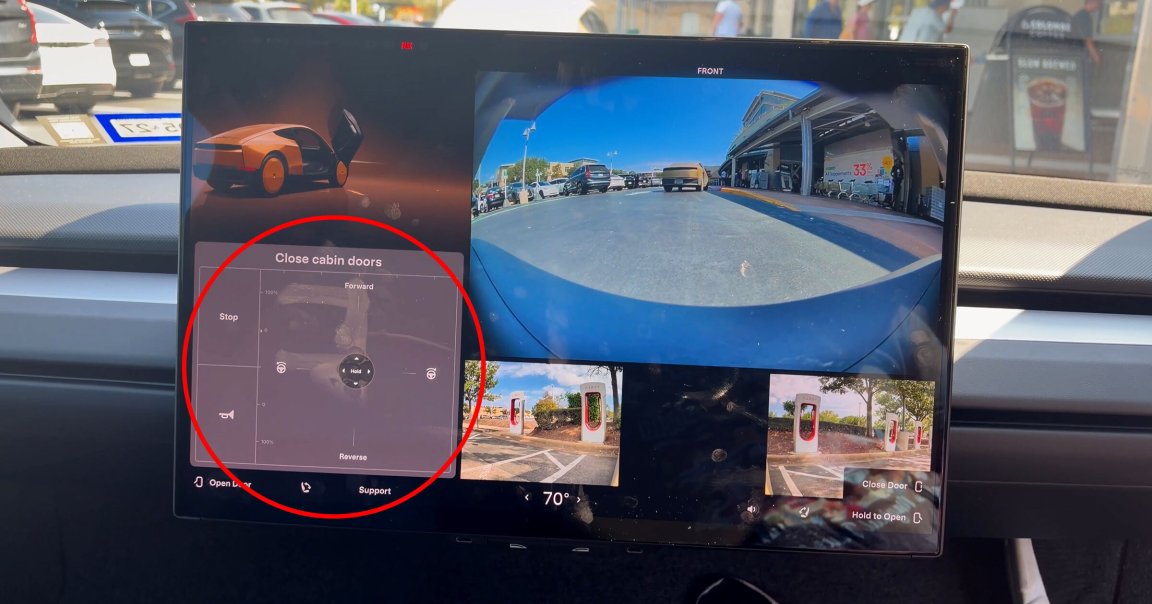
The passenger, Matthew Skrzypczak, wrote on X over the weekend that when he got in his Cybercab to take it for a spin, the display, instead of showing an interface to let him start his ride, showed a “virtual joystick for manual driving.”
“I have a feeling I wasn’t supposed to see this,” he wrote.
In a video he uploaded, the display shows a splitscreen view of various camera angles and an area that lets you control several of the car’s functions. Crucially, there’s also a touchscreen joystick for shifting the car into gear, which says “forward” at the top and “reverse” at the bottom.
Skrzypczak was able to close the door and honk the horn successfully, but when he tries to move the car it doesn’t budge — which is probably for the best, since there were pedestrians nearby — though this may be because he was simply using the joystick wrong.
This feature is almost certainly intended for Tesla employees, and it’s unclear why a passenger like Skrzypczak, and at least one other who noted the issue, was able to access it. To be clear, manual controls are obviously necessary in case an employee or emergency workers needs to move the vehicle when it’s malfunctioning. But putting it behind a slippery touchscreen is also far less practical than an old-fashioned steering wheel and pedal, which is all being done so CEO Elon Musk can have bragging rights.
The workaround hasn’t proved amusing to regulators. Shortly after Tesla launched Cybercab rides in Austin, the National Highway Traffic Safety Administration opened an audit into how Tesla self-certified that the vehicles were safe for the road despite their lack of conventional manual controls.
More on Tesla: Tesla Driver Killed After Self-Driving Mode Stops in the Middle of a Highway