

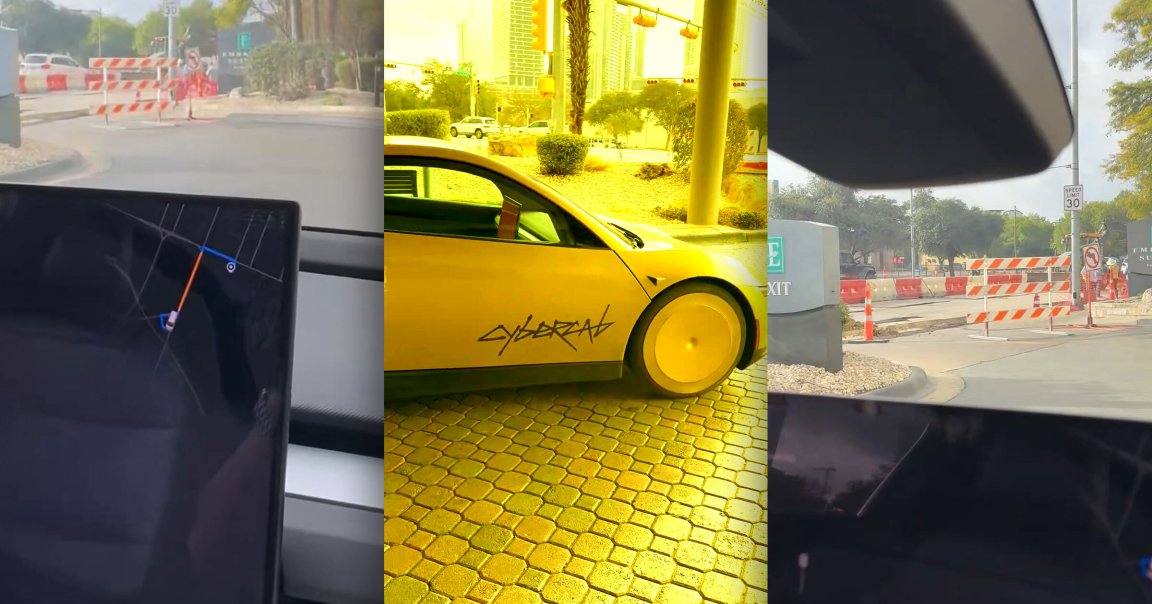
In Austin, a man’s attempt to be chauffeured out of his hotel in style was foiled when his confused ride couldn’t even pull out of the building.
His ride, of course, was a Tesla Cybercab — Elon Musk’s self-driving, steer-wheeling free robotaxi.
“The Robotaxi arrived… and then couldn’t get out of the hotel parking lot,” the man, who claims to be a computer engineer, wrote on X, posting brief footage of his trip.
As he went on to explain, construction workers had blocked off one of the lanes. And the gleaming gold Cybercab, in all its canny computing power, couldn’t see the other lane that was left open.
He never made it to his destination, but he did arrive at a destination, albeit rather unceremoniously. The Cybercab “drove back and forth four times,” he said, “and then stopped and said I had arrived!”
“Not a great first experience!” he concluded. “Clearly this technology is nowhere close to being ready for large scale deployment.”
Tesla rolled out its two-seater Cybercabs in Austin earlier this month, after years of anticipation. The company had already operated a Robotaxi service in the city for over a year using modified Model Ys, but the Cybercab represents its first purpose-built robotaxi — and with its complete lack of driver controls like steering wheels and pedals, its no-turning-back commitment to pursuing genuine human-free driving. (Many of its Robotaxis still requiring a human safety monitor inside the car, something the company is clearly conscious about.)
It hasn’t made quite the splash that Tesla may have hoped, however, with many investors underwhelmed by the Cybercab’s launch. While the golden cars haven’t been involved in any high profile incidents yet, the software’s autonomous capabilities haven’t stacked up impressively next to robotaxi leader Waymo. The company is also being investigated by federal regulators over how it self-certified that the vehicles were safe for the road despite their lack of conventional controls.
The Cybercab’s hotel misfire is part of a long chain of weird behavior by Tesla’s robotaxis. Customers — many of whom are Tesla enthusiasts and boosters — complain that they often pick up and drop them off at inconvenient locations, ranging from the middle of busy intersections to hidden alleys, or at absurd distances from their actual destination.
Still, Tesla boosters have been hard at work trying to hype up the cars. Roughly a week before a Cybercab got trapped at a hotel, another Tesla account posted a video bragging about how a Cybercab picked them up from their own hotel.
“You’ll feel like a VIP getting into this car!” he extolled.
More on Tesla: Cybercabs Are Taking Psychotic Routes That Turn Tiny Trips Around the Neighborhood Into Hour-Long Nightmares