

Spiders from Mars? Try Europa.
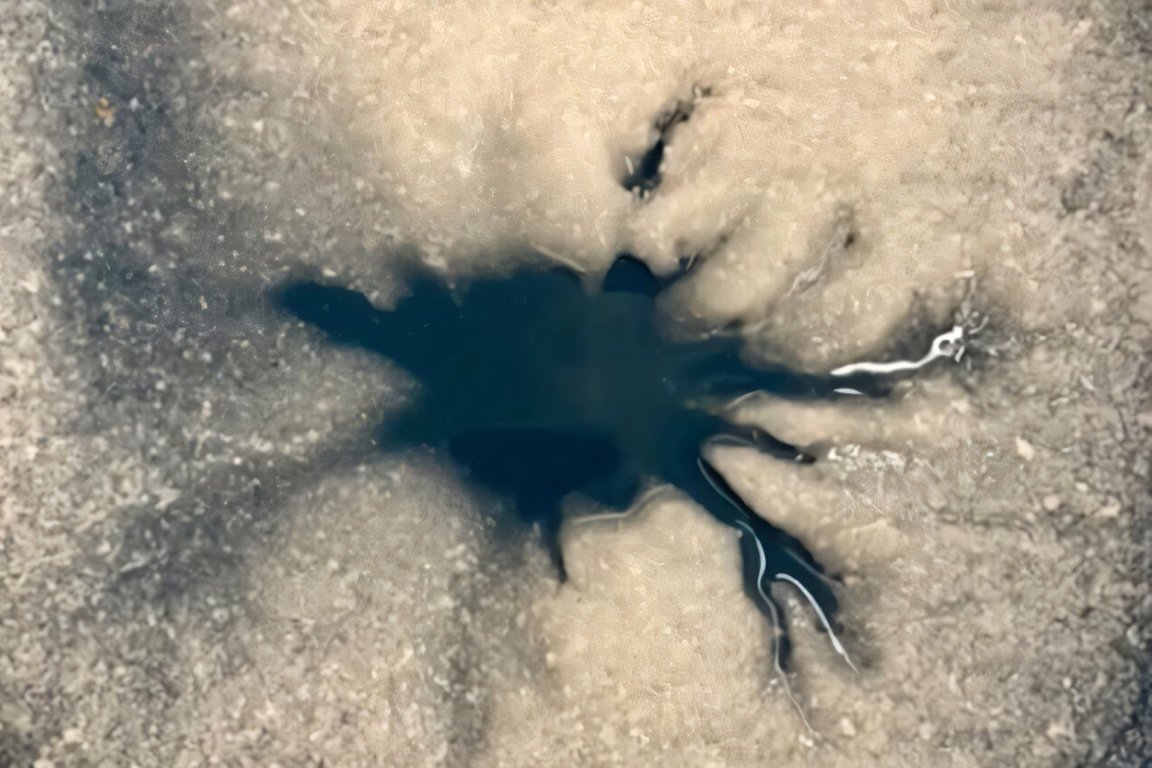
A team of planetary scientists from Ireland have examined and named an intriguing feature on the surface of Jupiter’s icy moon that resembles the shape of an arachnid — or perhaps an exploded asterisk.
They’re calling it “Damhán Alla,” which is Gaelic for “spider,” or in a particularly evocative phrasing, “wall demon.”
The team’s analysis, published as a study in The Planetary Science Journal, suggest that Damhán Alla, and other features like it, may be the festering wounds formed by torrents of water erupting through Europa’s icy shell.
“The significance of our research is really exciting,” lead author Lauren Mc Keown, a physicist at the University of Central Florida, said in a statement. “Surface features like these can tell us a lot about what’s happening beneath the ice. If we see more of them with Europa Clipper” — NASA’s new space probe currently en route to Jupiter — they could point to local brine pools below the surface.”
Europa is the smallest of Jupiter’s four Galilean moons, and is of interest to astronomers because it’s suspected to harbor a saltwater ocean underneath its icy surface, making it one of the most promising candidates for off-world life in the solar system. Its spider-like feature was first observed by NASA’s Galileo mission, which lasted between 1989 and 2003, during which the spacecraft performed 11 flybys of Europa.
For the study, Mc Keown’s team compared Damhán Alla, which is roughly a kilometer across, with similar formations on Earth called lake stars, sometimes called ice stars. Typically a few feet in size, lake stars form when snow falls on the surface of a frozen lake and holes form in the ice, letting water melt away some of the snow in radial, branching patterns. Scientists call these patterns dendritic, and that they’re seeing such patterns on Europa’s surface suggest another sign of water breaking through its surface.
The hypothesized scenario, in this case, is that some sort of impact to the moon’s icy shell allowed briny water to seep through the shattered ice. This would also point to the existence of a vast subsurface ocean, or at least small pools of water right beneath the surface.
“Lake stars are really beautiful, and they are pretty common on snow or slush-covered frozen lakes and ponds,” Mc Keown said. “It is wonderful to think that they may give us a glimpse into processes occurring on Europa and maybe even other icy ocean worlds in our solar system.”
More on space: Mysterious Interstellar Object Now Approaching Earth