

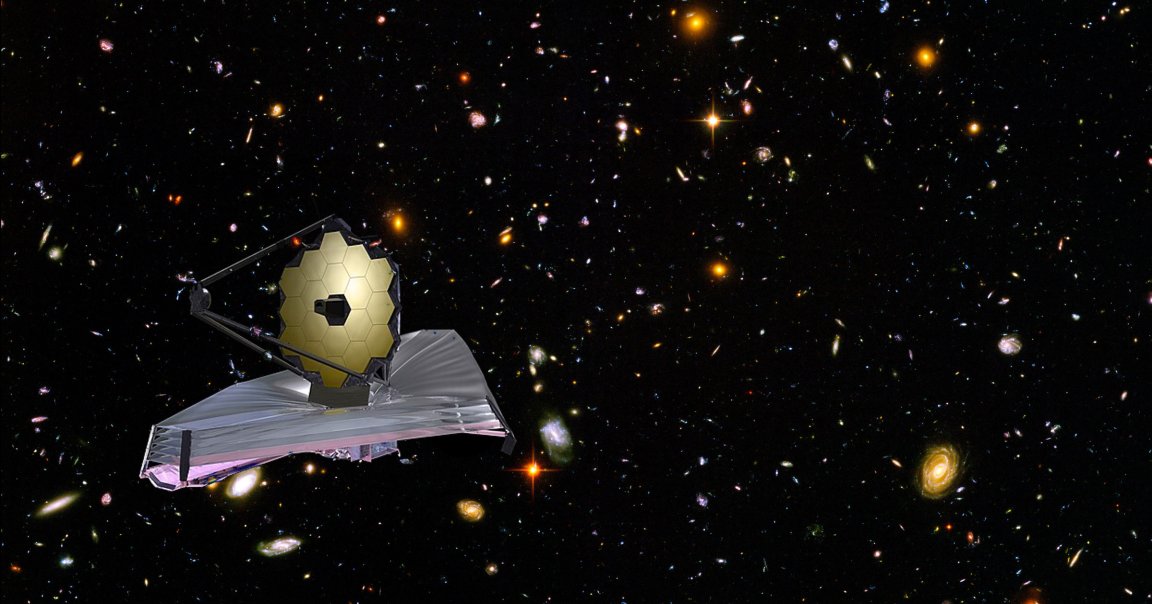
Using the NASA’s James Webb Space Telescope, a team of researchers led by University of Minnesota astrophysicist Mason Huberty had a closer look at a group of almost 10,000 galaxies spanning billions of light-years in the Fornax constellation. As detailed in a new paper published in The Astrophysical Journal, they honed in on a small space in the region that they thought was entirely unoccupied.
But to their astonishment, they observed a single emission line emanating from it — twice over a span of just three months. Emission lines are bright, narrow bands of light emitted at a specific wavelength by distant celestial objects and other phenomena. Puzzlingly, prior observations from the same region didn’t feature the same reading.
Put simply, the JWST stared into the abyss — and the abyss stared back.
Instead of hunting down already known objects, Huberty and his colleagues tried to use the James Webb’s Near-Infrared Spectrograph to uncover new ones, as Science Alert explains. The team examined what they thought was an empty region twice, in August and November 2023, at different angles to rule out any artifacts.
Out of seven total detections of emissions in the region, one stood out because they couldn’t match it to a distant galaxy.
It also stood out as the only near-infrared emission without any other accompanying emission lines near it. It should’ve also shown up in earlier James Webb observations since it’s technically bright enough — but didn’t.
The astronomers offered several possible explanations, none of which “provide a fully satisfactory explanation,” according to their paper. The emission line may have been produced by a galaxy dating back to the earliest days of the Universe. It could’ve also come from a younger galaxy or a supernova, both of which are usually accompanied by other emission lines. Finally, the researchers propose that it could’ve been the result of a black hole devouring a star — a guess that would require plenty of other data to confirm.
“Follow-up observations are essential to confirm the redshift and determine the physical origin of the emission,” the team concluded in their paper. “Deeper, more sensitive spectroscopy could reveal additional emission lines and definitively establish the redshift and nature of the source.”
More on the James Webb: Astronomers Discover an Entirely New Type of Object: a “Black Hole Star”