

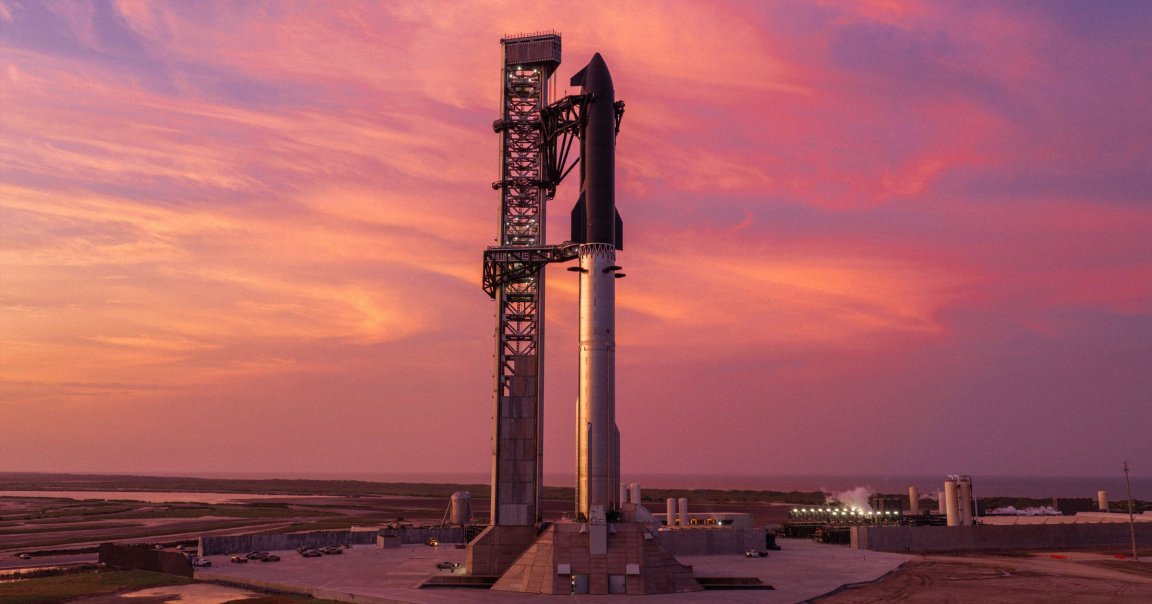
It feels like SpaceX’s Starship development has been in a bit of a holding pattern as of late.
The company’s most recent launch in July, which was its thirteenth full-scale test in almost three and a half years, saw the spacecraft successfully deploy 20 operational satellites. But only ten out of its Super Heavy booster’s 13 Raptor engines relit during its landing, causing it to make a hard impact and explode.
Now the space company is looking to finally stick the landing. This coming Monday, the company is planning to launch its fourteenth test flight, “pending regulatory approval.” The plan is to have Starship circle the Earth a full six times over ten hours at an altitude of 171 miles before lightly touching down.
It’s almost certainly the biggest test of the launch platform yet, and arguably the most important launch in the company’s history. Proving its orbital flight capabilities is mission critical if SpaceX ever wants Starship to deliver satellites at a regular cadence. It’s also a key aspect of NASA’s planned Artemis 3 mission, which is currently slated for 2027, a key stepping stone in the space agency’s ambitions to return astronauts to the lunar surface.
But give the sheer number of challenges SpaceX still has to overcome, from reliably entering orbit to sticking the landing of both its spacecraft and its booster, SpaceX may need to buy itself some more time before it can get NASA astronauts aboard its spacecraft in the Earth’s orbit next year.
SpaceX successfully conducted a full wet dress rehearsal earlier this week ahead of its Monday launch attempt. Without igniting any engines, the company’s team ran through the countdown procedures to ensure everything’s ready.
Learning from its previous test launch, SpaceX modified the hardware of its Super Heavy booster to ensure all of its engines light up and guide it safely for a splashdown in the Gulf of Mexico.
“The Super Heavy on this upcoming flight has hardware modifications to improve filtering to the engines and software changes to enhance relight reliability,” the company’s website reads.
After its almost ten-hour stint in orbit, Starship will attempt to splash down in the Pacific Ocean west of Chile while using an upgraded heatshield to ensure it doesn’t burn up during reentry. The company will even reuse two heatshield tiles that it recovered from its previous test launch, the “first tile reuse for Starship.”
It will also deliver 26 Starlink V3 satellites to “greatly expand the network’s capacity and user speeds.”
A lot is riding on the success of next week’s launch. The company is preparing to wind down its workhorse Falcon 9 rocket in favor of its much larger Starship platform, which can theoretically deliver roughly ten times as many satellites per launch.
But whether that’s even on the table — let alone have an Artemis version successfully perform a trans-lunar injection and deliver astronauts to the surface of the Moon as soon as “early 2028” — is something we could find out as soon as Monday.
More on Starship: SpaceX Is Learning a Nasty Lesson About Going Public When Your Main Product Is Experimental