

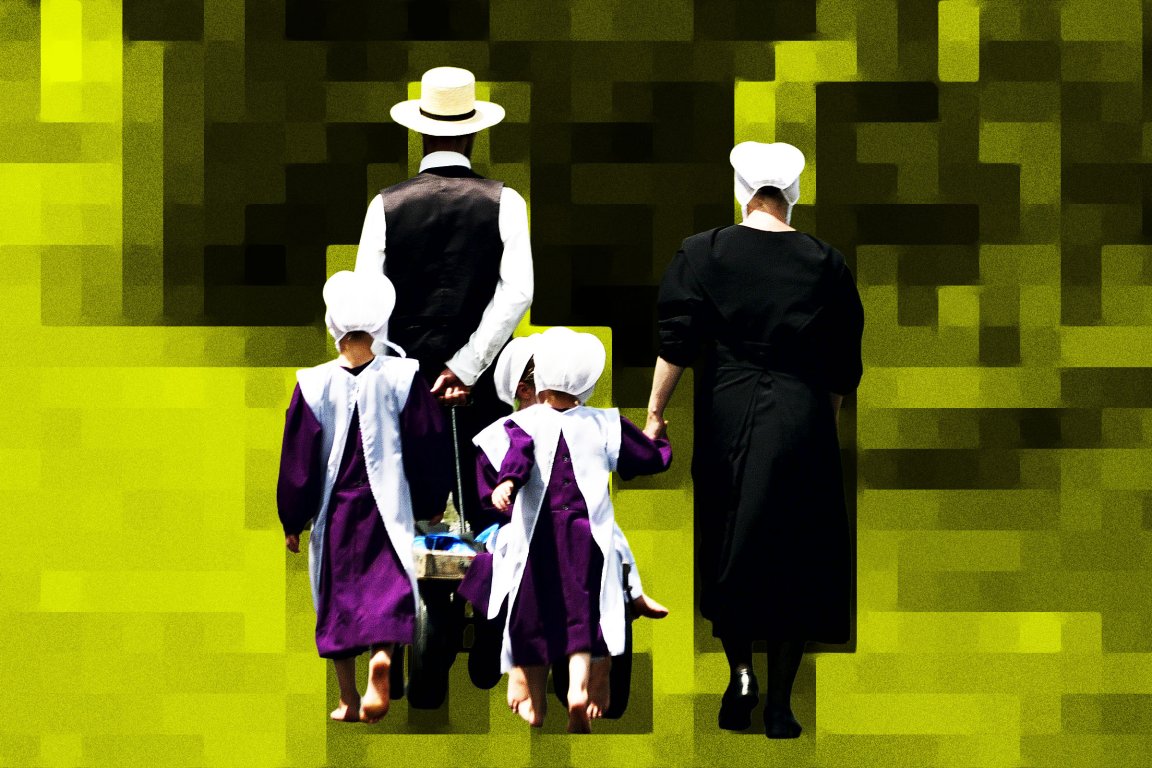
AI is reportedly making inroads in a famously tech-cautious community: the Amish.
According to a fascinating story by New York Magazine, the men of Holmes County, Ohio’s Amish community — the area with the largest concentration of Amish people in the country — have embraced generative AI as a new tool to do things like write emails, draft contracts, create spreadsheets, and otherwise manage their oft-family-run businesses in fields like manufacturing, construction, and agriculture.
“I started using it soon after it came out, more or less testing it,” Ian Wengerd, an Amish father-of-six who owns a metal-fabrication company, told NY Mag. “The more I used it, the more I thought this could actually be a good thing.”
Wengerd, whose business employs about 30 staffers, explained to the magazine that his business gets “involved in some state work, federal work, private work.” In other words, he’s busy — and he says that without tech, chatbots included, he and his many employees would be out of a job.
“For us to try to do business with just a fax machine and a voicemail,” said Ian, “I’d have to shut my doors.”
Not all Amish folk enjoy access to the internet, and when they do, it’s generally quite limited. (One expert, historian Marcus Yoder, told NY Mag that he believes that fewer than half of Holmes County’s Amish population is online, and of that population, he estimates that under 10 percent have given AI a whirl.)
Not a single person NY Mag spoke with uses a smartphone; they either use zhuzh-ed up “dumb phones” or flip phones. Their digital life is also heavily filtered through Christian censoring services and almost entirely restricted to the workplace. But media censorship aside, that stark line between the workplace and the home, interestingly, seems to make for some healthy technological boundaries.
“I can’t lay in bed for half an hour asking Chat stuff. So the times when I’m vulnerable it’s not at my fingertips,” Ian’s cousin John Wengerd, a 19-year-old chicken salesman and property manager, told the magazine. “When I go home, I’m riding a horse or feeding chickens.”
This narrow but optimistic adoption of chatbots, as described by the men interviewed, does track with the religious community’s historic approach to emerging tech, if and where it adopts it. It’s an overwhelmingly utilitarian outlook, and though most AI users likely aren’t able to jump on a horse at the end of the workday to help whittle down their screen time, maybe take their approach as a reminder that AI shouldn’t be a constant companion.
“I don’t want to paint a picture that we’re pushing for new technology and we don’t have respect for our traditions and our values,” business owner and minister Daniel Wengerd — indeed, another cousin — told NY Mag. “We’re not just opening the door to anything.” That said, according to the piece, Daniel did use ChatGPT to write his wife a Valentine’s note.
More on AI and religion: A Bunch of Incredibly Sleazy AI Apps Are Claiming to Be Jesus Christ Himself