

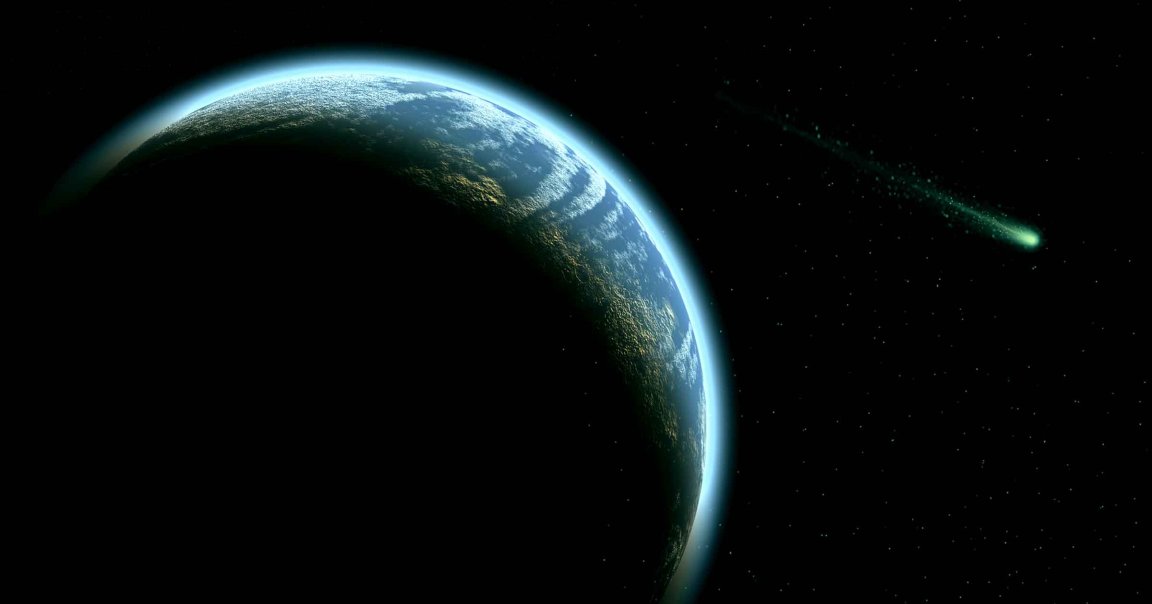
For thousands of years, astronomers have watched Halley’s Comet come and go, becoming visible to the naked eye every 72 to 80 years. That makes it a short-period comet, whose highly elliptical orbit takes it beyond Neptune before making its decades-long return. (The last time we caught a glimpse of the comet was in 1986, while its next appearance is slated for mid-2061.)
Other comets take far longer to orbit the Sun. As the New York Times reports, comet C/2025 R3 PANSTARRS, which was only discovered last year, has been visible to stargazers in the northern hemisphere for weeks now. However, once it’s on its way out, it’s not expected to return for another 170,000 years.
It’s origin is of particular interest to astronomers, who believe it came from the Oort Cloud, a giant spherical shell that blankets the solar system, representing the outermost edge of our star’s gravitational influence. Researchers believe it’s chock full of icy and rocky objects like C/2025 R3 PANSTARRS.
Long-period comets are an exceedingly rare sight — and an exciting opportunity to get a precious glimpse of the furthest reaches of the solar system.
“Whenever we spot them, it’s the first time we’ve seen them, and it’s also the only time that we will see them in our lifetimes,” Te Whatu Stardome in New Zealand resident astronomer Josh Aoraki told the NYT.
Whether future civilizations will be able to see the visitor again isn’t guaranteed. As the Perth Observatory’s Matt Woods points out in a recent guide, gravitational interactions with the solar system’s planets can eject comets form our star system altogether.
Given its suspected origins, studying a “dirty snowball” comet like C/2025 R3 PANSTARRS could provide us with tantalizing clues about the earliest days of the solar system. Current theories suggest that tiny chunks of leftover planet-making material dating back billions of years, called planetesimals, were driven away from the Sun when the planets formed. While some left the system entirely, others were trapped between a region where galactic influences balanced out with the Sun’s gravity, a region that’s now known as the Oort cloud.
The movement of these objects may have even played a role in delivering the necessary building blocks that allowed life on Earth to form, according to Woods.
In other words, there are plenty of reasons to get out the telescope before C/2025 R3 PANSTARRS is too distant to be visible to amateur astronomers.
“So while C/2025 R3 PANSTARRS might appear as little more than a faint, fuzzy patch through binoculars, it represents something far more significant,” Woods wrote. “It is a relic from the birth of the Solar System, a frozen archive of cosmic history, and for a brief moment, it’s visible from right here on Earth.”
“Not bad for something you can spot just after sunset,” he added.
More on comets: Please Resist the Urge to Drink the Melted Sludge From 3I/ATLAS