

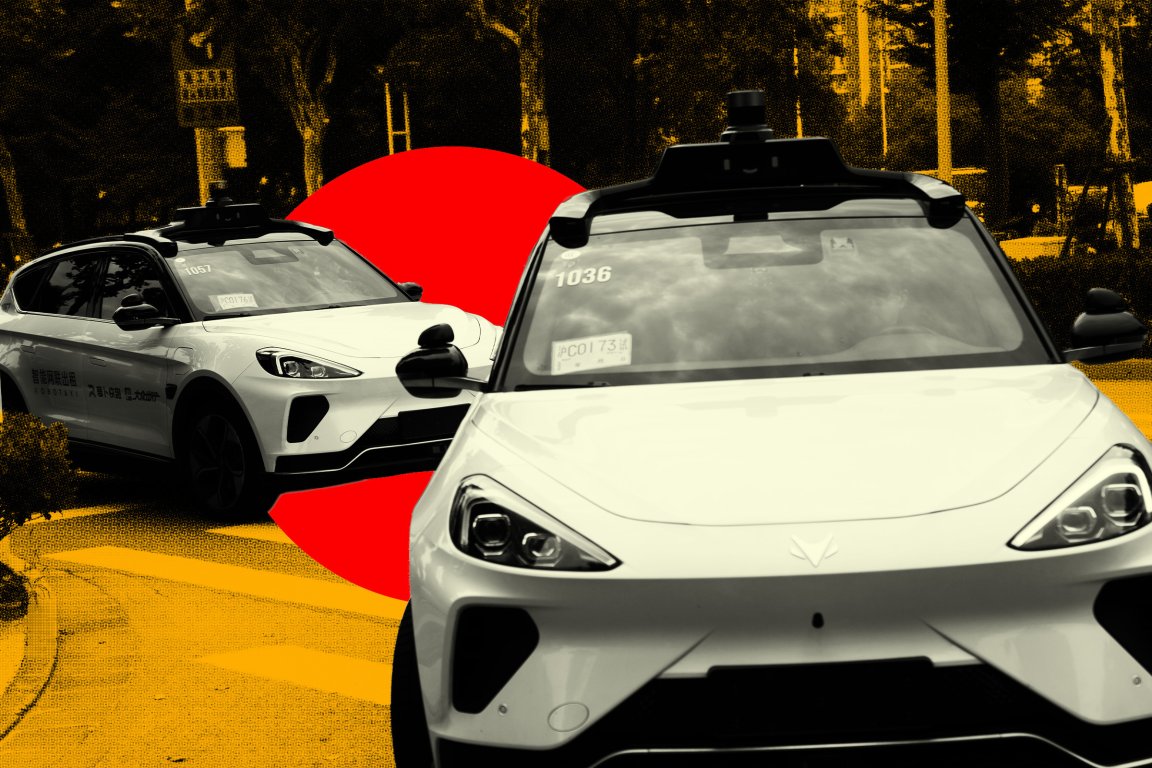
A massive system failure on Tuesday left over a hundred robotaxis stranded in the streets of Wuhan, China, Wired reports, with dozens of the cars stopping dead in the middle of traffic and even highways.
The robotaxis are operated by Baidu, a Chinese tech conglomerate which has deployed hundreds of the self-driving cars in the central China city.
Footage uploaded to social media paints a partial picture of the chaos. One dashcam video — it appears to be this one — shows a driver passing at least 16 of Baidu’s Apollo Go robotaxis that stopped in the road in the span of 90 minutes, according to the magazine’s reporting, congesting traffic. Others showed them halted in highways, sometimes in the fast lane.
The outage appears to have resulted in at least three crashes. On the Chinese social media site RedNote, a user who uploaded dashcam footage says he rear-ended a stranded Baidu robotaxi after the car in front of him suddenly changed lanes to avoid hitting it, leaving him little time to react, per Wired. The magazine also found videos of two other collisions, with one RedNote user confirming she drove past a van that slammed into the rear of a Baidu cab.
For passengers, the experience was no less chaotic. One told Wired she was stuck in a Baidu robotaxi with two friends for 90 minutes on the night of the outage, and described their frustrating attempts to reach customer support.
The car, according to the passenger, stopped four to five times before finally parking in front of an intersection that, fortunately, wasn’t busy. A screen in the car told them to stay put because a company rep would come by in “five minutes,” but when no one came, they spent another half hour trying to reach customer support. When support told them nothing helpful, she and her friends decided to exit the vehicle, which was not locked, and go home.
Other passengers fumed about similar experiences on RedNote, with one complaining that pressing the robotaxi app’s “SOS button” returned a message saying it was unavailable. “So then what exactly is the SOS for?” they wrote, quoted by Wired.
Baidu has not responded to media requests for comment. Authorities in Wuhan issued a statement that night saying that the incident was “likely caused by a system malfunction” that is still being investigated.
Fortunately, despite the spate of collisions, no injuries have been reported.
Initial reports paired with the footage suggested at least dozens of Baidu robotaxis were stalled in streets. Per Reuters, however, a traffic police officer in a video published by the Shanghai outlet The Paper said that at least 100 Apollo Go vehicles were affected by the issue, though it’s unclear how many of them were in the middle of traffic when it happened. The cars weren’t locked, but passengers were scared to leave their vehicles because of heavy traffic, the official said.
The outage will go down as one of the largest and most disruptive robotaxis incidents to date, and provides a harsh reality check to Chinese companies’ rapid deployment of autonomous vehicles.
Of course, the lessons are equally relevant in the West. US robotaxi leader Waymo suffered an even larger disaster in December, when a power outage in San Francisco left hundreds of its cars, which were confused without working traffic lights, stalled in streets across the city. The Waymo cars piled up in intersections, blocked roads, and interfered with emergency vehicles.
Waymo had to send employees to physically retrieve 64 of its stranded robotaxis, which all together stopped for two minutes or more nearly 1,600 times during the outage, the San Francisco Standard reported. Unlike the Baidu incident, the Waymo one didn’t result in any major collisions, underscoring the risks of deploying robotaxis on highways as Baidu as done — a capability that Waymo officially deployed in November.
More on robotaxis: Tesla Admits Its Robotaxis Are Being Driven Remotely