
OpenAI has faced protests on and off for years. But after its CEO Sam Altman announced a new deal with the Department of Defense over how its AI systems would be deployed across the military on Friday, it’s being barraged with an intensity of backlash that the company has never seen.
Droves of loyal ChatGPT users declared they were jumping shipping to Claude, whose maker Anthropic had pointedly refused to cut a deal with the Pentagon that gives it unrestricted access to its AI system — even in the face of government threats to seize the company’s tech. Claude quickly surged to the top of the app store, supplanting OpenAI’s chatbot. Uninstalls of the ChatGPT app spiked by nearly 300 percent.
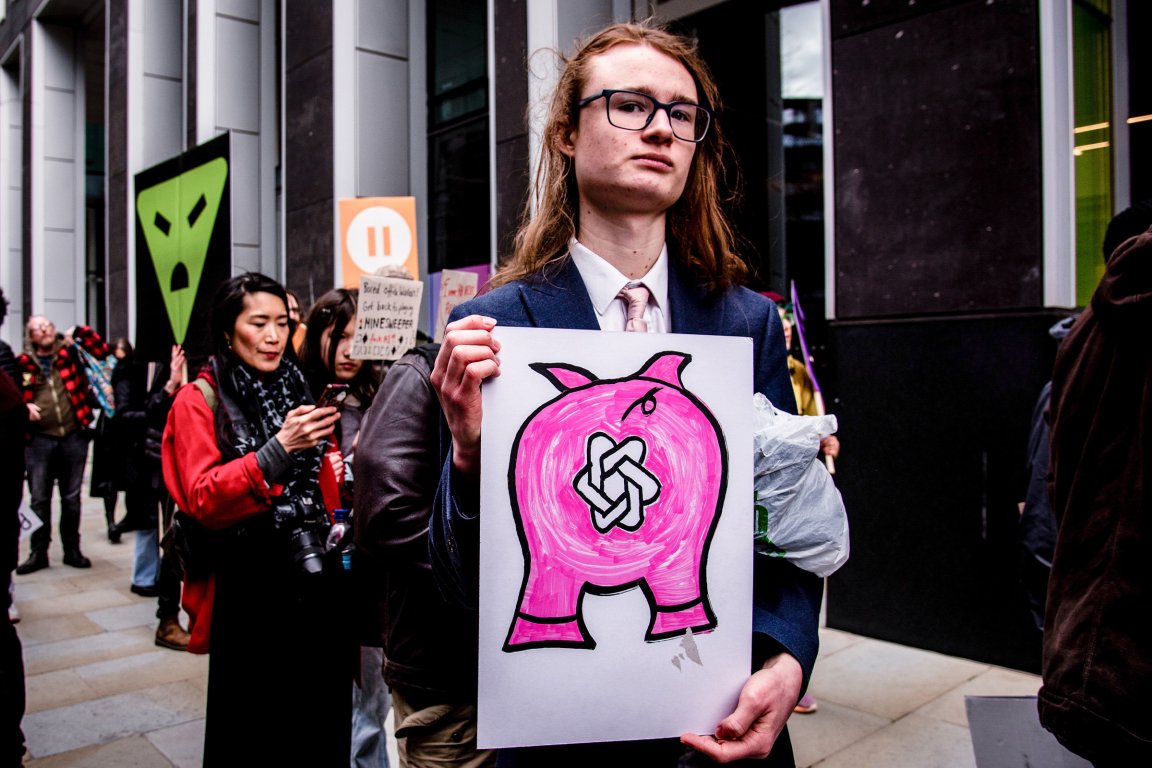
Now, some are latching onto the wave of anti-OpenAI sentiment to voice broader critiques of the company. On Tuesday, some fifty protestors from the “QuitGPT” movement demonstrated outside of OpenAI’s headquarters in San Francisco, decrying everything from its AI’s potential to disrupt jobs, to gutting the environment.
“AI is taking water from communities, polluting communities, and it is also increasing communities’ electricity bills,” one protestor, Perrin Millekin, told Business Insider. “They’re not even paying for it — we are.”
Others voiced more philosophical critiques.
“As soon as I saw it start showing up in visuals and imagery, I could see exactly where it heads,” Megan Matson, who refuses to use any AI, told BI. “It destroys journalism, it destroys art, it destroys the expression of our common humanity.”
Even tech workers were in attendance. “I never go to protests. This is new for me,” a 26-year-old Oakland tech worker who wore a cardboard robot mask told the San Francisco Standard. “We’re not normally political people. We’re techies, you know — we want to build stuff. What OpenAI is doing in terms of building legal mass surveillance technology for the government… is frankly, insane.”
Across the pond, hundreds of more activists gathered in King’s Cross in London, a tech hub home to the UK headquarters of OpenAI, Meta, and Google DeepMind, on Saturday to voice similar critiques of the AI industry.
Altman has clearly been rattled by the widespread outrage. He hosted a rare AMA on X to directly address his customers’ concerns the day after he announced the DoD deal, where he strikingly admitted that the agreement was “rushed,” and that its “optics don’t look good.”
By Monday, he was in full damage control mode. In a lengthy and apologetic statement, Altman claimed that OpenAI was now altering the terms of its Pentagon deal to explicitly prohibit the use of its AI systems to surveil US citizens, exhibiting a degree of people-pleasing normally witnessed in its sycophantic chatbots. Such a restriction was one of the red lines over which Anthropic had reportedly fallen out with the Pentagon. But Altman in his apology statement made no mention of Anthropic’s other key guarantee: that AI not be used in autonomous weapon systems.
This isn’t the first time OpenAI has faced protests for its cooperation with the military. In February 2024, dozens of activists thronged near the entrance to the company’s HQ after it removed a stipulation that banned military and warfare applications from its usage policies. Mere days after the revision, OpenAI announced that it was collaborating with the Pentagon on several projects.
Strikingly, some of the current dissent is even coming from the company’s own ranks. Nearly 1,000 workers from OpenAI and Google have signed an open letter demanding the companies to refuse the Pentagon’s demands to use their AI tech for mass surveillance and autonomous weaponry.
More on AI: After Banning Anthropic From Military Use, Pentagon Still Relying Heavily on It in Iran War