

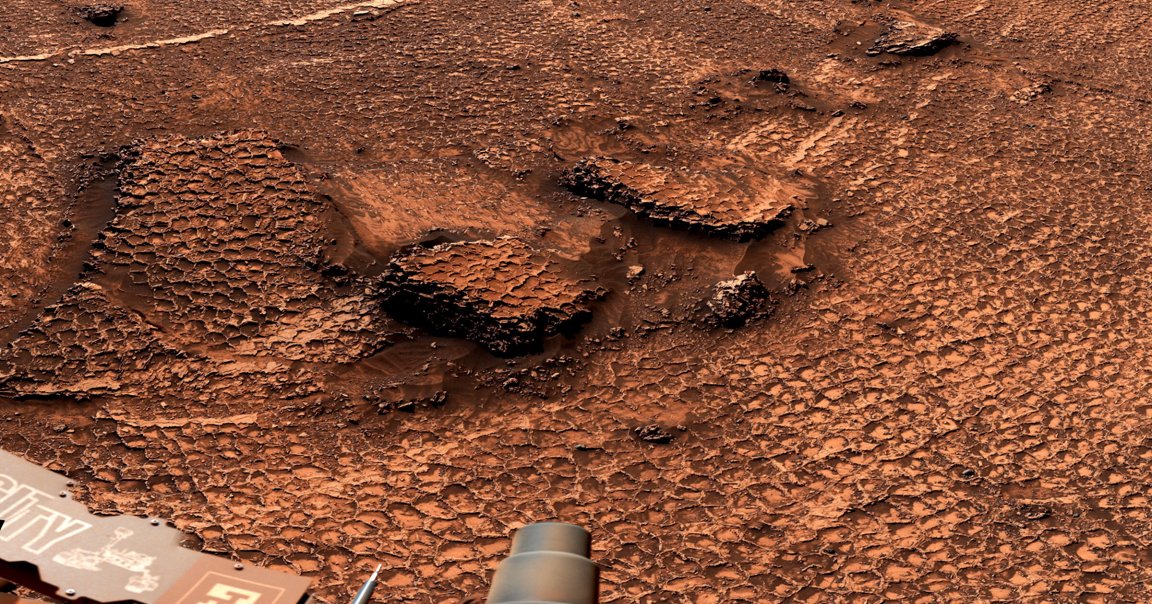
A vast field of mesmerizing polygons has left Mars scientists enthralled.
Don’t be mistaken: NASA didn’t send a robot across the solar system so its eggheads could get a rundown in basic geometry. Instead, the Curiosity rover stumbled upon a stretch of the Martian valley called “Valle Grande” where the landscape is defined by honeycomb-shaped patterns ranging two to four inches in diameter.
These so-called “polygonal fractures” have been spotted elsewhere on the Red Planet, but never texturing an entire landscape at such a scale.
“We’ve seen a lot of fascinating landscapes through Curiosity’s eyes, but this sea of polygons took our breath away,” project scientist Ashwin Vasavada at NASA’s Jet Propulsion Laboratory said in a statement. “We measured their shapes and chemistry carefully and are hopeful there are clues in the data as to how these features formed.”
The Curiosity rover stumbled on the polygon field while ascending the foothills of a three-mile-high mountain called Mount Sharp, where it’s been roaming since 2014. Captured with its Mastcam instrument, a panorama composed of 340 images taken back on June 19 show the hexagons dominating a huge stretch of the landscape.
On Mars, polygonal textures are generally mud cracks. What created them hints at the planet’s fascinating geological history: the honeycombs can form as a result of water drying up and causing sediments to shrink, or they can be carved out by extreme temperature swings. By studying these features, scientists hope to piece together how flowing water once helped shape the Red Planet’s surface.
More on Mars: NASA Rover Finds “Complex Organic Matter” on Mars