

Solar energy is booming.
By the end of the year, photovoltaics are expected to account for 10 percent of the world’s energy production, by which point it will have eclipsed even nuclear fission by sheer production capacity. As industrial supply chains make solar-generated electricity cheaper than ever before, a growing body of research indicates that solar farms are a net positive for many reasons — which makes recent anti-solar regulations all the more vexing.
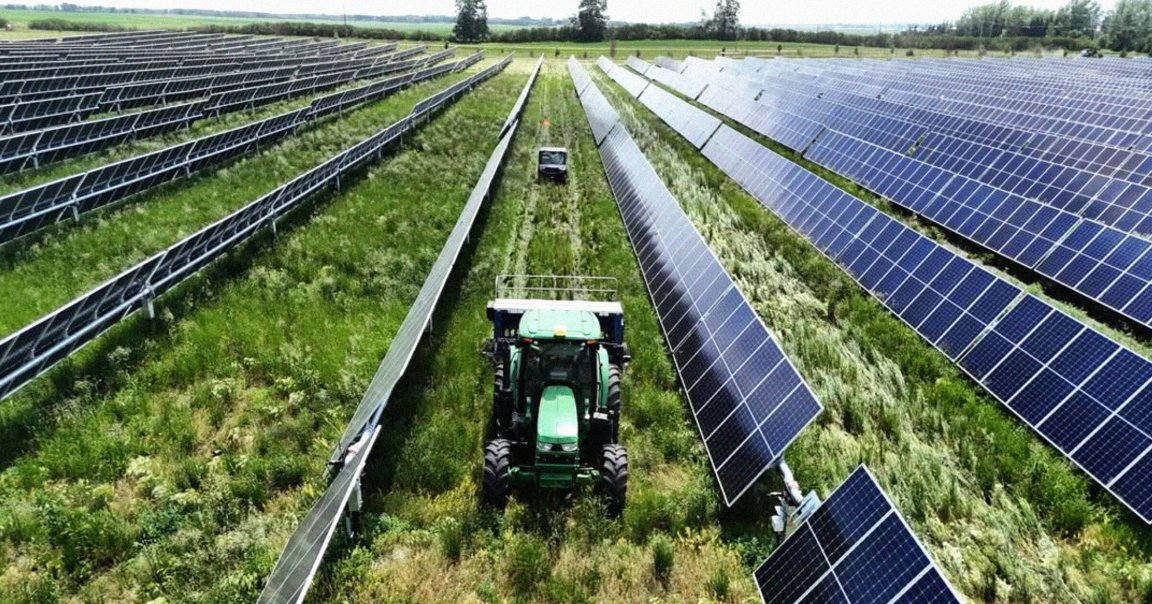
New reporting by the Calgary Herald took a look at a 480-acre farm in southern Alberta, owned and operated by a man named Mark Owerko. Thanks to a transmission line located near his land, Owerko was situated in a prime area to establish a solar farm. After eight years, his property became a combination solar plant, apiary, and sheep farm.
That’s a winning combination, according to a paper published in the journal Environmental Research Letters. According to the study, allowing just two sheep per hectare to graze the grasses growing around photovoltaic installations improves the abundance of bees and beneficial beetles by 38 percent, driven mostly by an 83 percent increase in adjacent honey bee populations compared to solar farms mowed by hand.
As the paper’s lead author Leana Zoller told the Cornell Chronicle, “sheep grazing and beneficial insect habitat are two prominent conversation topics around solar development right now.”
Despite what seems like a win-win both for Owerko and Alberta as a whole, the Herald notes that similar developments are nearly-impossible under the provinces’ current regulatory environment. That’s thanks in large part to restrictive rules around renewable energy on agricultural land meant to preserve “pristine viewscapes.”
As Owerko explains, his solar project was one of the very last approved by Alberta before the government imposed a seven-month moratorium on new wind and solar development.
“The moratorium drove power pricing into a ditch,” Owerko told the Herald. “In doing that, they chased away investment.”
“Everywhere else in the country, we see renewables being added to the grids at an accelerating pace and winning even in markets that are not specifically contracting for renewables,” director of the Business Renewables Centre of Canada Jorden Dy told the paper. “In Alberta, we’re seeing a complete slowdown.”
Whether Alberta can solve its renewable energy woes and restart solar investments in the province remains to be seen. Its regulatory regime is part of a strange trend emerging among some state- and provincial-level governments throughout North America, where restrictive and short-sighted regulations dictate which green energy developments are allowed on private land.
More on solar energy: Venture Capitalists Disgusted by Solar Power Because It’s Generating Too Much Clean Electricity to Be Grossly Profitable