

There are plenty of safety concerns to consider when deploying robots in workplaces like warehouses alongside human workers. They can lead to malfunctions, injuries, fires — and in extreme cases, even deaths.
And now that we’re inching closer to a reality where two-legged humanoid robot coworkers are a common sight at the jobsite, some companies are taking the implications of having powerful machines work in close proximity to humans seriously.
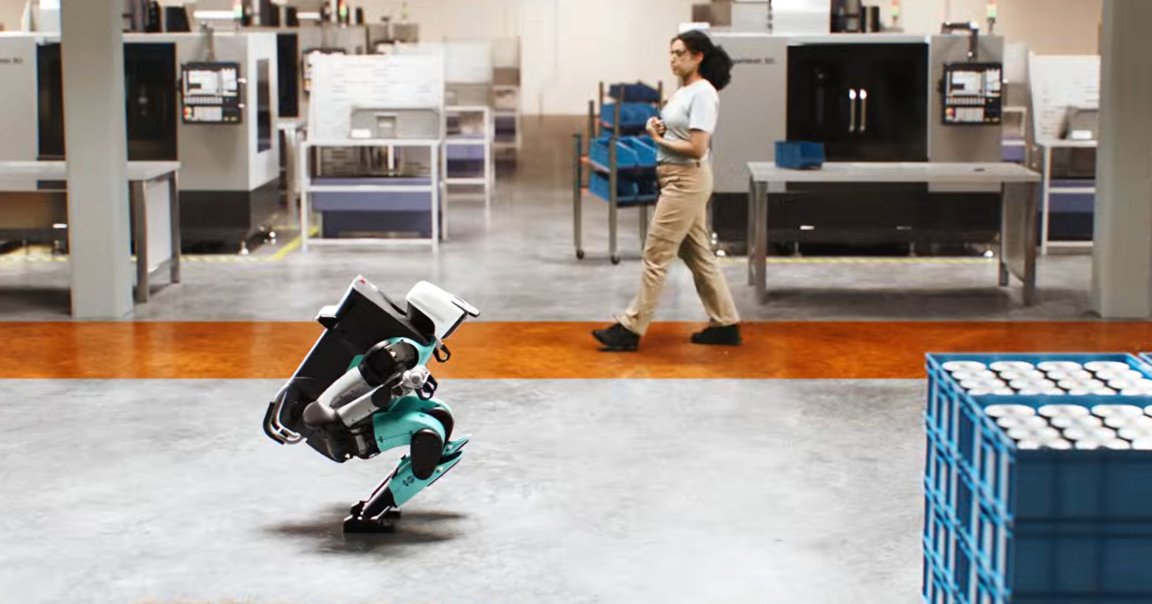
Case in point, robotics company Agility Robotics unveiled its latest “general purpose” humanoid robot, dubbed Digit 5, earlier this week. The bot leverages “proprietary AI algorithms” and sensors to “continuously monitor for people and take appropriate action by autonomously avoiding, stopping or assuming a seated position.”
In practice, that means the hulking bot cowers in apparent fear and drops to its knees when a human turns the corner, as seen in a promotional video (around the 43 second mark). It’s a fascinating new dynamic that feels oddly reassuring in a world where human interests are quickly becoming subordinate to the demands of AI.
Digit 5 can autonomously decide to move out of the way of an oncoming human or stand still if somebody were to pass by.
“The robot was designed with a complex safe motion system that can take a variety of different mitigations depending on exactly what sort of human presence is detected,” Agility Robotics CTO Pras Velagapudi told Ars Technica.
The company has made considerable headway in deploying its fleet of robots in commercial operations run by companies including Amazon and Toyota. By doubling down on safety, Agility is hoping to expand its business appeal.
Digit 5 features a bespoke AI chip from Nvidia, called Thor IGX, to continuously monitor for the presence of humans nearby. It collects data from a host of vision-based sensors and uses its onboard chip to detect any movement in real time.
It can also repeatedly lift up to 50 pounds, giving it “full coverage of single-person lift tasks in OSHA-regulated facilities,” according to the company.
Its battery lasts for 90 minutes, while a full charge takes just nine minutes, “enabling more than 20 hours of productive work in a 24-hour day.”
As humanoid robots continue to infiltrate human workplaces, we’re glad that safety concerns are being taken seriously. Having a robot drop to its knees if a human comes too close certainly instills a lot more confidence than if it were the other way around.
More on robots in the workplace: No, McDonald’s Isn’t Deploying Humanoid Robots as Workers in Shanghai