

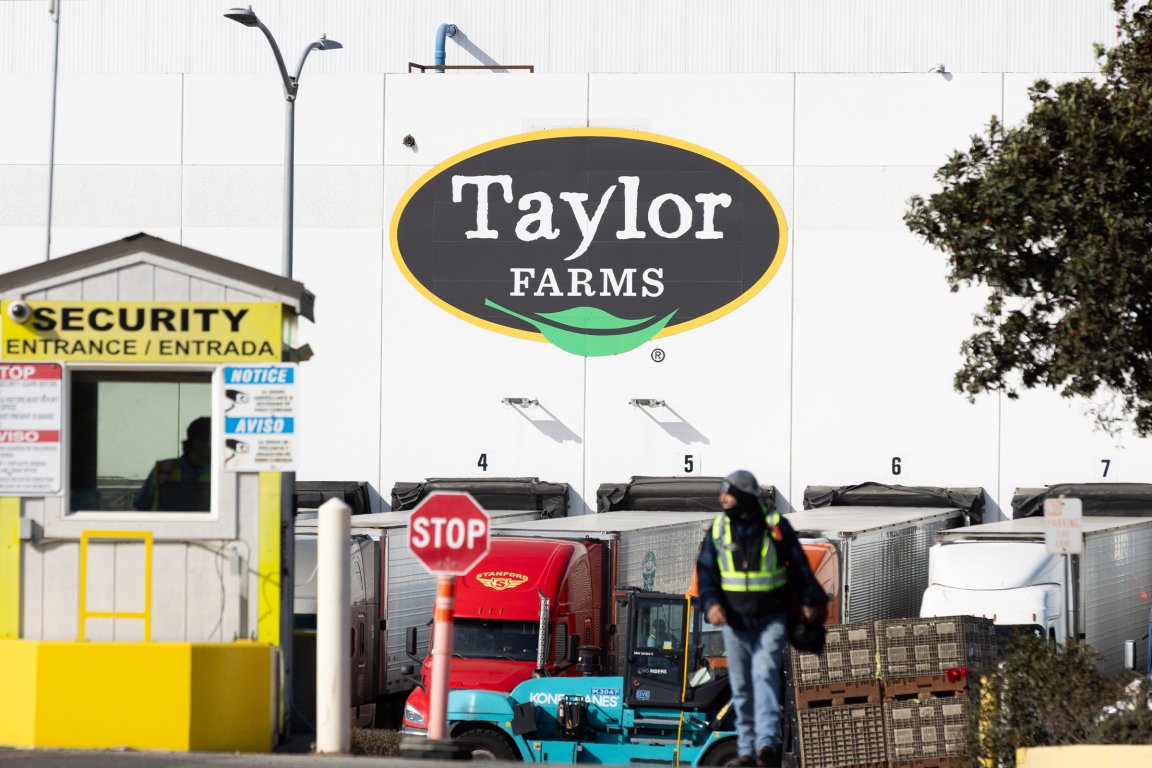
In a stunning reversal on Sunday, the Food and Drug Administration said that lettuce samples from Taylor Farms did not, after all, test positive for the microscopic parasite Cyclospora cayetanensis, which is behind the rising outbreak of explosive diarrhea sweeping the nation.
Health officials have been racing to control the intestinal infection, which fortunately is not deadly, but can cause weeks of violently watery diarrhea.
By Saturday, the FDA said it had found traces of the parasite in shredded iceberg lettuce supplied by Taylor Farms — one of Taco Bell’s lead suppliers — only to change its mind just one day later.
“To be clear, at this moment, FDA has not identified a single positive product test result for cyclospora,” a Taylor Fresh Foods spokesperson told Reuters in a statement.
The bizarre 180 leaves far more questions than answers. And further muddying the waters was lawyer and public health policy leader Matthew Cortland’s stunning discovery about the food supplier’s relationship with the Trump administration.
In a post on Patreon, Cortland found that Taylor Farms had made a $1 million donation to the Trump-aligned super PAC MAGA Inc on March 26, 2025. That’s just six days after the FDA announced it was pushing back the implementation of its “Food Traceability Rule” by 30 months.
The rule, which was originally meant to go into effect on January 20 of this year, would’ve established “traceability recordkeeping requirements beyond those in existing regulations, for persons who manufacture, process, pack, or hold foods,” according to the regulator’s website.
Considering the effort would’ve allowed, in the words of the FDA, for the “faster identification and removal of potentially contaminated food from the market, resulting in fewer foodborne illnesses and deaths,” the agency’s decision to move back the compliance date raised eyebrows. (Congress even doubled down earlier this year, forbidding any funds to be appropriated to enforce the Food Traceability Rule before July 20, 2028.)
Where all of this leaves the ongoing outbreak of explosive diarrhea is tough to say. As Cortland points out, the Centers for Disease Control and Prevention has only acknowledged a small fraction of the cases of the illness so far. As of Friday, that’s 1,644 cases across five states. However, compared to reported tallies from individual states — Michigan alone has reported over 6,000 cases as of Monday — that’s likely vastly underestimating a more widespread phenomenon.
One reason for the discrepancy could be the difficulty of confirming the presence of the parasite with a lab test, a process that requires painstakingly dying eggs and then examining samples under a microscope. The parasite can’t be grown in a lab, greatly hampering scientists’ efforts to trace the outbreak.
“You’re looking for a needle in a haystack,” food-safety professional Jennifer McEntire, who consults for Taylor Fresh Foods, told the Wall Street Journal. “With E. coli and salmonella if you find it you can make the needle bigger. That doesn’t happen for cyclospora.”
Nonetheless, in terms of public health messaging, the ongoing outbreak is clearly causing far more confusion than it should, highlighting massive budget cuts that allow outbreaks like the current one to flourish.
And chances are that the situation could get even messier as the parasite spreads. The Trump administration’s FDA and USDA have lost tens of thousands of workers last year amidst budget cuts. A food surveillance program called FoodNet that monitored eight common foodborne pathogens is now no longer required to keep tabs on the cyclospora parasite. A team responsible for identifying parasitic outbreaks across the US was cut from 11 people to just three in September, as CNN reports.
For now, Taylor Fresh Foods will still have to recall its iceberg lettuce — despite the FDA now claiming the samples it viewed did not test positive after all.
More on the outbreak: Let’s Be Real, The Explosive Diarrhea Outbreak Is Trump’s Fault, Not Taco Bell’s