

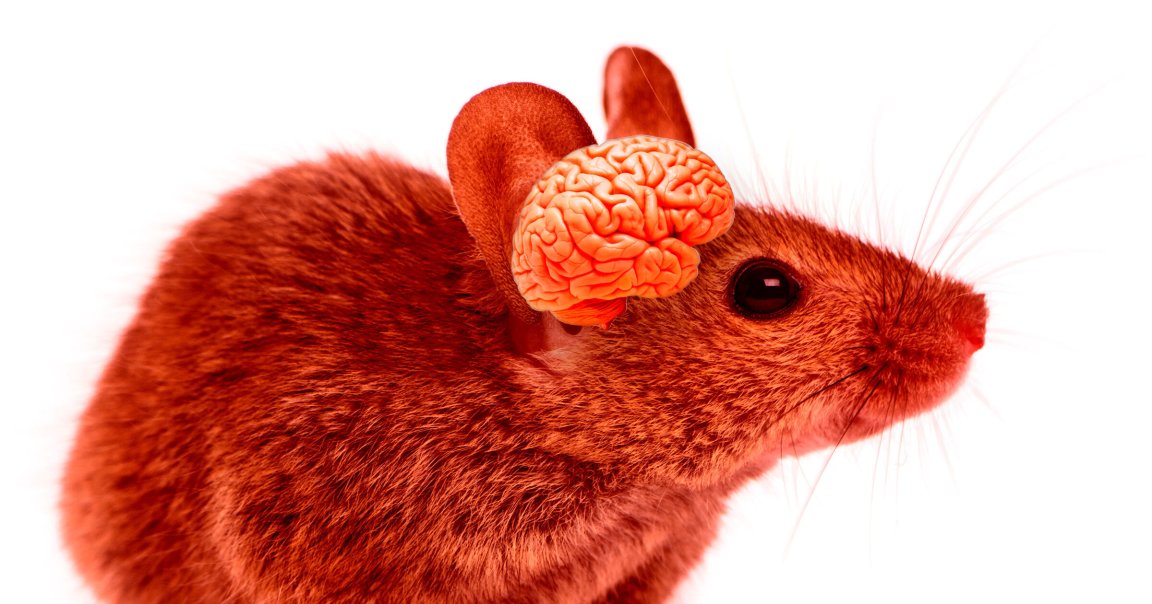
Scientists have created mice with brains that have millions of functioning human neurons fused into them. This groundbreaking feat could provide a new avenue for understanding and treating neurocognitive disorders, though the Frankenstein-esque nature of the work will surely raise ethical questions.
In a new study published in the journal Nature, the Stanford University scientists report how they used genetic engineering to deliberately create mice with parts of their brain missing — namely a key region called the cortex. By also stripping the mice of the ability to replenish these cortex neurons, this carved out a space that they could implant human brain cells.
Not only did the implanted human neurons take hold, but they multiplied dramatically, blooming from just a few hundred neurons to several million, and successfully connecting with the mouse brain. The mice themselves, meanwhile, largely behaved as normal, despite nearly half their brains now being human by volume.
“For the past two decades, there’s been a quest to try to build models of the human brain outside of the human body,” senior author Sergiu Pașca, a Stanford professor of psychiatry who worked on the mice, told NPR. “This is not going to replace all the models we had before, but it’s going to provide us access to other aspects of human brain function that would be very difficult to study otherwise.”
The work is a stunning leap forward in the field of developing brain organoids — small clusters of human brain tissue that’re grown in a lab. The researchers used human skin cells and reprogrammed them so they would form the neurons found in the cortex.
The cortex is significant, as it’s the “part of the brain that results in our humanness,” John Evans, a bioethicist at the University of California, San Diego, who was not involved in the study, told the New York Times, as it controls our high-level thinking and our ability to use language.
The implanted human neurons weren’t mature, however, resembling those found in a third trimester fetus.
While the mice largely moved and behaved as normal, they showed key human-like differences. When the researchers deprived baby mice with human neurons of oxygen around birth, they found that the rodents exhibited signs of brain damage. This is striking, because normal mouse pups exposed to low oxygen rarely face brain damage, while human babies often do.
“This is an ideal example of how you can study this devastating disorder,” Pașca told the NYT.
They also found that the human parts of the mice brains contained a long, specialized type of brain cell called a von Economo neuron, which is only found in highly social animals like humans, apes, whales, and elephants. Crucially, von Economo neurons are some of the first brain cells to die in patients with a frontotemporal dementia, and their presence in the mice could help explore their role in the rare form of the disease.
The project raises sensitive ethical considerations, though. Nita Farahany, professor of law and philosophy at Duke Law, drew attention to how the researchers cut off the experiments right when the brain cells reached six months old, which is before they could form further connections to the mouse brains.
“They’re trying to stop the study before the markers of consciousness, or the fact of consciousness, might emerge,” Farhany told NPR. “But that line itself is a line that you might start to wonder about.”
“Do you stop a study before an animal develops consciousness, if it has the potential or is on its way to develop consciousness?” she continued. “Does it have different interests or rights that we would assign to it?”
More on brains: Wild New Paper Claims Human Brain Doesn’t Produce Consciousness