

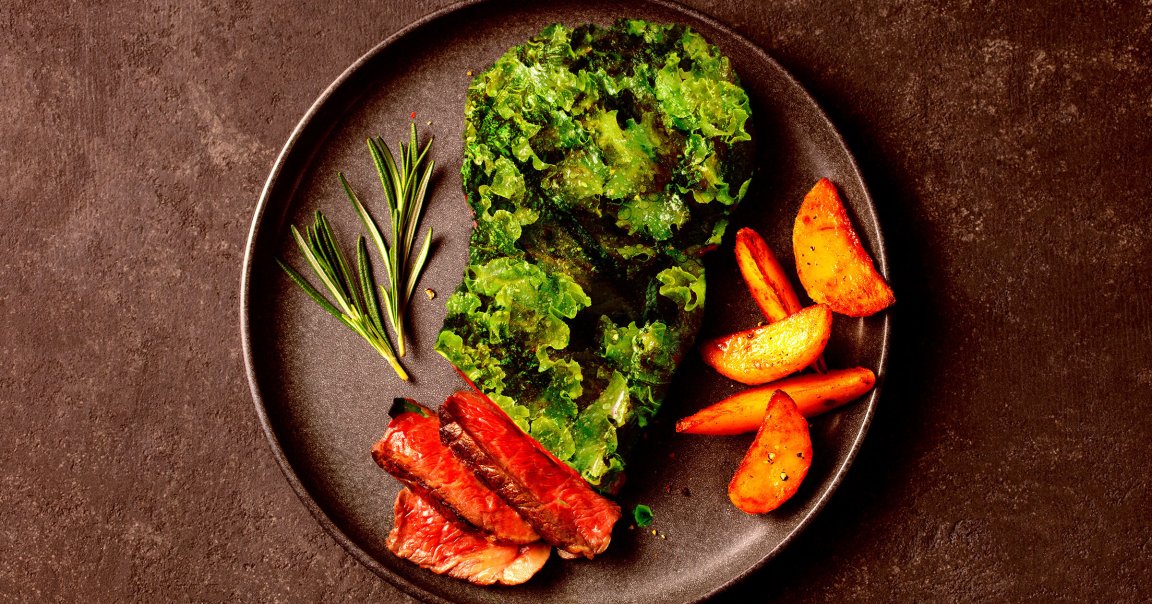
Scientists have finally created what might be the only thing that can get meatheads to eat their veggies: protein lettuce.
By literally shooting pig genes into the chloroplasts of lettuce and tobacco cells, an international team of researchers were able to grow produce that contained the animal protein myoglobin, they report in a new study published in the journal Frontiers in Plant Science.
Is this the pathway to the next ridiculous protein-infused snack? (We’re looking at you, protein popcorn.) Not quite. Instead, the scientists say their findings could pave the way to weaning ourselves off of environmentally-destructive meat.
“Our study demonstrates, for the first time, that higher plants can stably produce myoglobin, one of the key proteins responsible for many of meat’s desirable properties,” study lead atuhor Alexia Groff, a plant biotechnology researcher at Imperial College London, told ScienceAlert. “This is very relevant at a time when the demand for sustainable food production platforms is greater than ever.”
To combine pig genes with plant DNA, the researchers used a machine called a biolistic particle delivery system, or a “gene gun.” The nickname is apt: it works by firing microscopic metal particles covered in genes into their target. (Biolistic, by the way, is a portmanteau of “biological ballistics.”)
The target, this time, were the chloroplasts of lettuce and tobacco seedlings. Because of their “bacterial ancestry and their high number of copies per cell,” Groff explained in a statement about the work, “chloroplasts are generally much better at making large amounts of protein than the cell nucleus.”
Their genetic bullets hit the bullseye. In followup tests, the seedlings showed they had incorporated the pig DNA into the chloroplast genome. When the plants grew into adulthood and produced seeds, their offspring still possessed the transferred genes.
In all, the lettuce and tobacco plants yielded about 800 mg and 810 mg of myoglobin protein per kilogram of their dry weight. That’s ten times less than beef, but because growing plants is far more efficient than raising animals, the tradeoff could be worth it.
“Plant cultivation is far more resource-efficient than livestock production; consequently, plant-derived myoglobin could achieve protein yields per hectare that rival — or even potentially exceed — those of animal agriculture,” the authors wrote in the study, “whilst also benefiting from substantially lower water use and greenhouse gas emissions.”
If this gets adopted at scale, these protein-infused plants could be dried up and be used to bolster the protein in plant-based meats.
Other researchers caution that the food still needs to be proven safe to eat and sustainable to produce, but are optimistic about the findings.
“This an important advance on earlier plant and algal research. Demonstrating stable myoglobin production in plant chloroplasts, including in an edible crop, raises the possibility of using plants as scalable, low-input production platforms alongside microbial fermentation,” Rodrigo Ledesma-Amaro, director of the ICL’s Bezos Center for Sustainable Protein, said in a statement. “In the longer term, this could diversify how and where these ingredients are produced.”
More on lettuce: Trump’s Explosive Diarrhea Scandal Is Getting Worse and Worse