

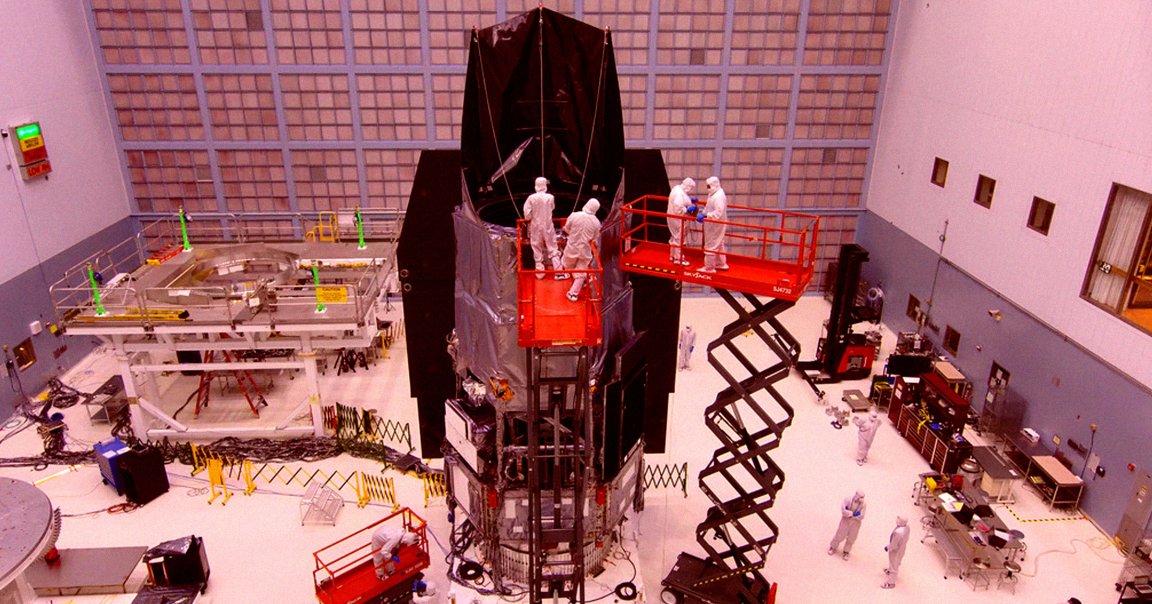
NASA’s Nancy Grace Roman Space Telescope has a lot to live up to. The orbital observatory, a long-awaited successor to the agency’s revolutionary Hubble Space Telescope, is set to launch on Sunday from the Kennedy Space Center on a SpaceX Falcon Heavy rocket.
Scientists have high hopes that the $4.3 billion observatory will deeply further their understanding of the expansion of the universe and identify exoplanets orbiting distant stars.
But the Nancy Grace Roman didn’t start its life as a way to study the cosmos. The National Reconnaissance Office, a government spy agency, offered NASA one of its surveillance satellites it wasn’t using — which was later transformed into the space telescope we know today. The original platform was developed to “spy on America’s adversaries in a post-9/11 world,” as Scientific American put it, but the program collapsed before it could be launched into space.
“The National Reconnaissance Office reached out to NASA,” Duke University cosmologist Daniel Scolnic told NPR, “saying, ‘We have this amazing satellite sitting in a hangar that we’re not using. And what what do you guys think about instead of pointing downwards, we point upwards, and you guys use it?'”
“It was a surprise to everyone when we heard that they just plonked [it on NASA’s Goddard Space Flight Center’s] doorstep,” Australian National University astrophysicist Brad Tucker told Australian broadcaster ABC News.
NASA had to put a lot of work into converting the spy satellite platform into the Nancy Grace Roman. It had to safely bolt several scientific instruments onto the platform, including a high-resolution infrared camera. The agency also had to make modifications so it could travel through deep space and reach Lagrange Point 2, some one million miles from Earth, where the James Webb Space Telescope is also located.
Scientists are hopeful NASA’s latest “Great Observatory” could help them refine our existing astrophysical model of the known universe.
“In the last few years, there have been measurements saying that model might be wrong — and that’s something that Roman will absolutely nail, whether the model’s right or wrong,” Scolnic told NPR.
It could also dramatically speed up observations into the heart of our galaxy — despite, broadly speaking, having the same resolution as Hubble.
“That one month of observations to survey our Milky Way galaxy would take about a century with Hubble,” Goddard astrophysicist and Roman senior space scientist Julie McEnery told NPR.
While it’s a highly unusual origin story, the Roman Space Telescope is officially both ahead of schedule and under budget, a major departure from its predecessors.
“When we get things right and have success stories like Nancy Grace Roman, let’s learn from some of the magic that created that outcome,” NASA administrator Jared Isaacman gloated in an April statement.
That’s despite the Trump administration having repeatedly attempted to kill the telescope since 2017.