
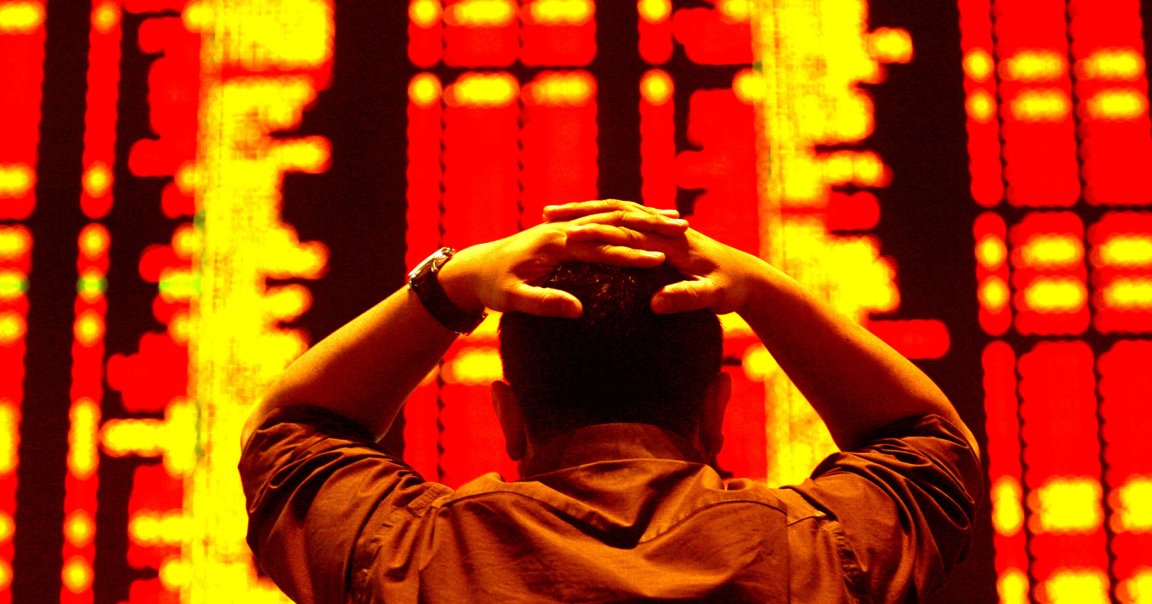
On Thursday, news that ChatGPT maker OpenAI was set to miss its annual revenue goal by a cool $20 billion sent stock markets into a tailspin. The tech-heavy Nasdaq index took the heaviest hit, falling 1.25 percent by the close of trading.
Of course, the stock market happily bounced back to a near-record high as soon as the markets opened on Friday, but the whole episode underscores how fragile the AI spending boom really is — and how little information we truly have from private AI labs which have no obligation to keep the public up to speed.
Perhaps jolted by the momentary slump, producers for Bloomberg TV‘s daily Open Interest broadcast brought on Joachim Klement, managing director and research analyst at investment bank Panmure Liberum.
As a financial analyst, Klement’s take on the AI economy has been notably grim — back in May, he penned an article in Reuters arguing that institutional investors shouldn’t be asking “whether the AI boom will end, but what will happen to markets when it does.” Now, his live interview on Bloomberg‘s flagship news channel underscores the degree to which the AI bubble is becoming impossible for mainstream commentators to ignore, even as some publications cite tech billionaires who insist the AI bubble is a myth.
“My core conviction is that the AI bubble will either burst in 2027 or in 2028,” Klement was quoted saying in his Bloomberg appearance. That conviction is prefaced on the belief that the US AI bubble is focused on the wrong kind of technology: namely, resource-intensive frontier models.
“I think the entire AI boom is investing in the wrong future of AI,” Klement said. “At the moment we’re investing into frontier large language models running in data centers, when it becomes, to me, more and more clear that the real future of AI is small language and open-weight models running on local desktop computers. And that, to me, indicates that we’re already over-invested in data centers as more and more of these applications move to smaller, cheaper models running locally.”
“I think we’ve over-invested and the realization will come that these earnings,” Klement continued, “that some people — who shall remain nameless at this point in time — expect to fill the prices, and earnings to grow into the prices, they won’t materialize.”
When Bloomberg anchor Dani Burger raised the elephant in the room — the trillions of dollars worth of data center infrastructure planned for the next few years — Klement explained that the entire investment ultimately depends on just a few tech companies whose grand plans may never pan out.
“When it comes to the underlying demand, if you strip out OpenAI and Anthropic’s demand, there’s hardly any demand there for AI compute that justifies the trillion-dollar investments that the hyperscalers alone are expected to do next year,” Klement replied.
To call Klement’s forecast “gloomy” would be an understatement. With the fate of the US economy now completely fused with the data center boom, any slowdown in AI spending will almost certainly spell disaster for everybody — not just the tech industry.
“If you had asked me two months ago, I would have said ‘that’s a bubble that can easily last another two years,'” Klement said. Now, “all I need for this bubble to burst is for growth plans to be revised downward, and for growth to slow down, because that already will change the earning’s outlook for basically the entire supply chain.”
More on AI: AI Is Creating “Doom Loops” All Over the Economy