

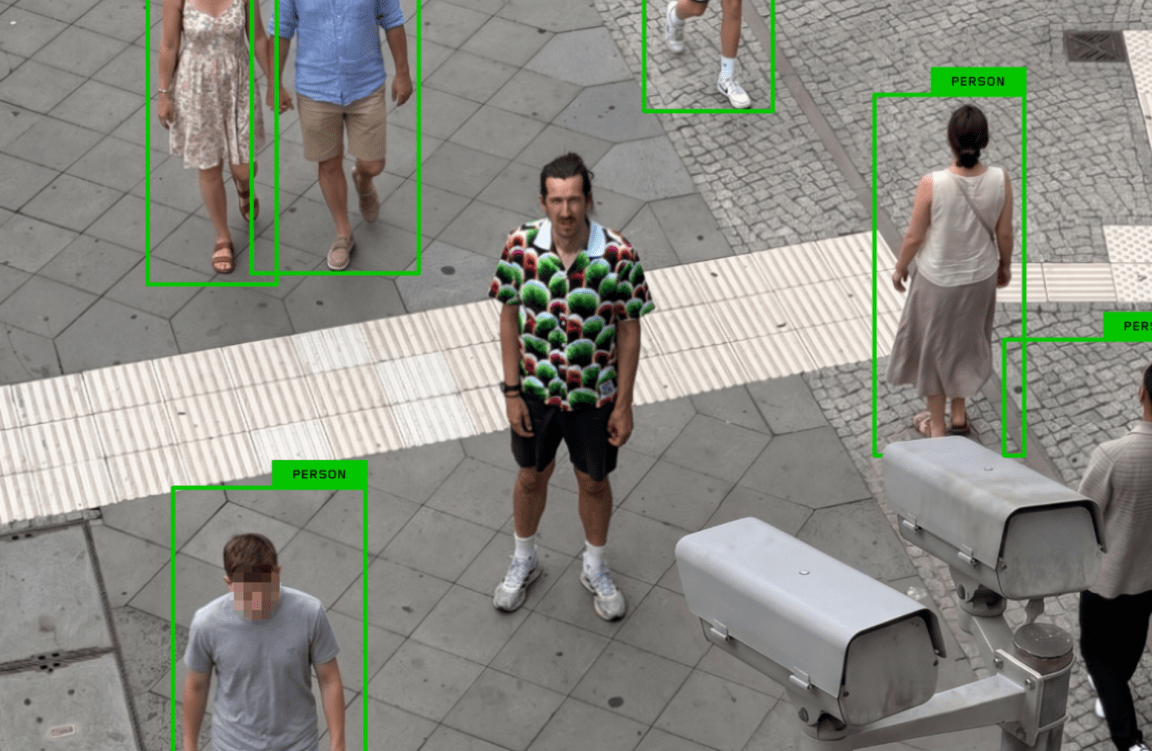
While some privacy advocates are content to saw down camera towers, one artist is pushing back against the panopticon with an unconventional tool: the ugliest aloha shirt you’ve ever seen.
Freshly reported by Dezeen, German designer Simon Weckert designed the hideous shirt to be untraceable to AI-integrated surveillance systems. Using a dizzying blend of colors and patterns, the shirt is ugly precisely because it’s designed to confuse surveillance algorithms — as Weckert explained, it’s the “interplay” of ghastly colors and shapes that hide its wearer from detection.
“AI systems are made of multiple layers and never learned what a human is — they learned what humans statistically look like in millions of training images,” the designer told Dezeen. “A ‘person,’ for the machine, is a bundle of visual statistics — and that is exactly its weakness.”
Specifically, the pink, orange and green blobs plastered on the shirt are meant to “break the continuity of the body’s outline,” Weckert explained, “so the detector can no longer bind the parts into one figure.”
“To a human it reads as an almost hypnotic textile; to the AI model it reads as nothing at all,” he said.
Ironically, Weckert used AI to design the pattern, using a kind of trial and error called an adversarial loop. It’s not unlike the “ugliest T-shirt in the world,” fictional garb imagined by William Gibson in his 2010 novel “Zero History.” (That particular shirt was described as “beyond punk, beyond art, and fundamentally, somehow, an affront.”)
A self-described “modern-day digital wizard,” Weckert previously made headlines in 2020 when he used a wagon filled to the brim with smartphones to trigger fake traffic jams on the streets of Berlin.
More on surveillance: Embattled Flock CEO Begs for “Compromise” As Backlash Spills Over