

In a whiplash-inducing turn away from the mythical quest to build human-level artificial intelligence, Western tech billionaires like Dario Amodei, Sam Altman, and Elon Musk are now joining hands to call for a massive slowdown of the tech’s development.
The commentariat is divided on what exactly this means — for some, it’s proof-positive of a genuine threat that AI could spin out of control and exterminate everybody. To others it’s a smokescreen, a thin cover provided by AI CEOs who are desperate for a government bailout to avoid popping the AI investment bubble.
If you ask lawmakers in Beijing, the whole thing is a bunch of nonsense.
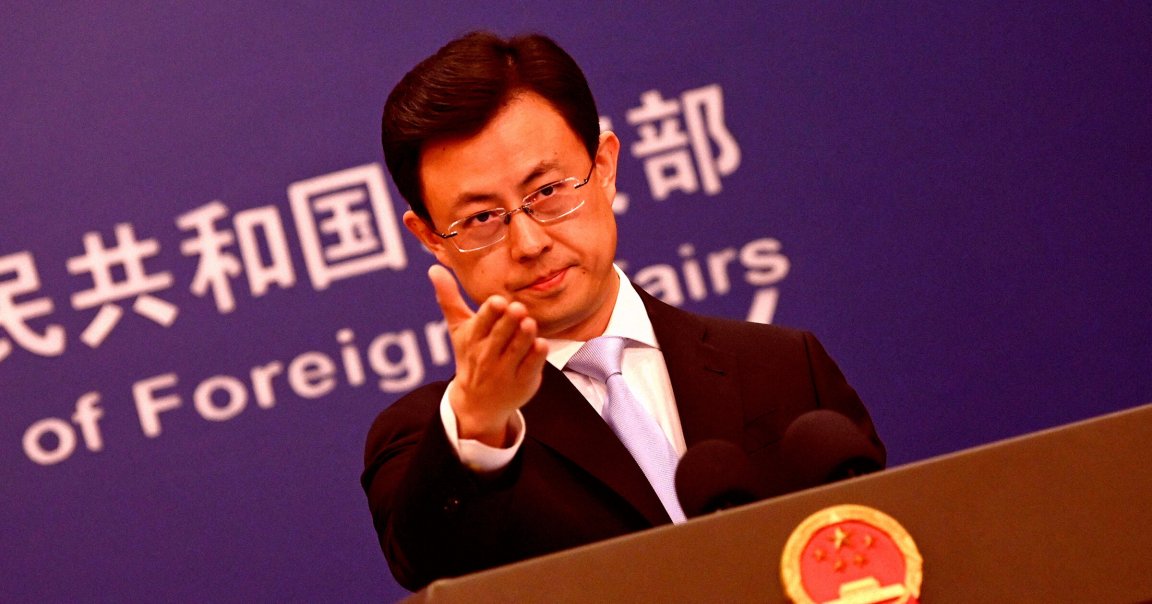
In a routine press scrum hosted by China’s Ministry of Foreign Affairs, government spokesperson Guo Jiakun addressed a laundry list of topics, from President Xi Jinping’s recent trip to New Delhi to recovery efforts around the devastating mudslides in Nepal. One of the questions, posed by a Reuters journalist, concerned whether the ministry had any comment on calls from American tech billionaires to slow down AI development.
“AI is a consequential technology for the wellbeing of all humanity,” Guo replied. “All parties should jointly promote the open and inclusive development of AI for good and for all. Fear-mongering, confrontation and vicious competition will only hamper efforts toward sound global AI governance, which serves no one’s interest.”
Compared to the weight given to other topics, the ministry’s statement on the Western AI debacle was decidedly terse. While talk of an AI slowdown is roiling US markets and trending on social media, it seems like it’s barely a blip on Beijing’s radar.
The virtual hand-waving follows the decidedly disinterested stance Chinese policymakers have taken toward the US approach to AI development, which for years has hinged on building toward human-level artificial general intelligence.
As research fellow at the partially US-funded Brookings Institute Kyle Chan wrote in February, Beijing’s concept of “AGI” is wildly different from the one used across the pond. While US policymakers and industry leaders treat the tech as a race to AGI where one winner takes all, their Chinese counterparts aren’t in any rush. The US might get there first, the idea goes, but like electric vehicles, cancer treatments, and smartphones, Chinese industry can quickly make up the difference.
“Let’s look at the history of the internet. It started in the US, but China quickly caught up and led in consumer applications — WeChat is a world-class example,” professor emeritus at the Hong Kong University of Science and Technology Yang Qiang said during a panel at the AGI Next Summit in January. “AI is similar — it’s a tool, and Chinese ingenuity will push it to the limit.”
More on China and AI: Top Chinese Court Issues Sweeping Legal Crackdown on AI Deepfakes