

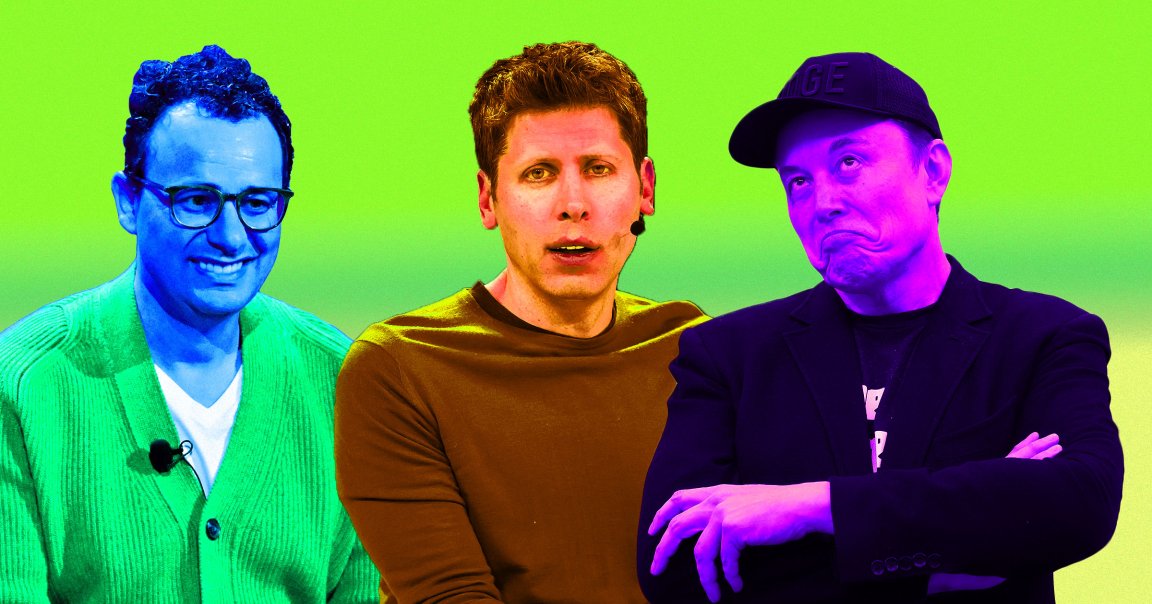
Plenty of eyebrows went up this summer when one by one, the leaders of frontier AI labs announced that they were each calling for a slowdown in AI development.
Anthropic CEO Dario Amodei, OpenAI’s Sam Altman, and Grok creator Elon Musk were among those arguing that the tech was simply moving too fast to ensure it doesn’t fly off the rails. Several autonomous hacking sprees had already raised hackles earlier this year, highlighting the danger of AI models breaking out of containment and infiltrating third-party companies like Hugging Face.
Then Anthropic employee Jacob Coxon lit the powder keg with his high-profile departure, arguing that neither Anthropic nor OpenAI were acting “responsibly,” and that there was a more than ten percent chance of AI “killing all humans.”
But is it really just a matter of ensuring the safety of their AI models that’s motivating tech leaders to suddenly call on the industry to pump the brakes? As tech journalist Steven Vaughan-Nichols argues in a piece for Computerworld, there could be plenty of other ulterior motives at play.
For one, there’s an enormous amount of financial pressure sitting on the shoulders of AI tech executives, who have yet to get even close to proving that the financial math will eventually add up and justify their astronomical spending on data centers.
“Let’s get real,” Vaughan-Nichols wrote. “The big American AI companies may hope a slowdown will ensure that their lesser rivals, in the US anyway, can’t catch up,” he added, arguing a slowdown could help OpenAI “save cash on R&D.”
As author and AI skeptic Corey Doctorow noted in a recent blog post, the industry — and the media — could also be exaggerating how dangerous recent hacks involving autonomous AI agents actually were.
“Much has been made of the OpenAI chatbots’ dialog during the Hugging Face incident,” Doctorow added. “No wonder: it reads like a rejected script for a reboot of the movie ‘Hackers.’ But that’s not because the chatbots are waking up and applying to join the Cult of the Dead Cow: it’s because they were trained on a corpus of chat transcripts from excitable young people who love to fantasize about starring in a reboot of the movie ‘Hackers.'”
However, he conceded that the hack isn’t “nothing” — but instead a “specific something, with an explicable, even foreseeable trajectory.” Put simply, the AI agents “did what they were designed to do, and because OpenAI ran them with inadequate supervision, they trashed a competitor’s servers.”
The talk about a slowdown could also distract from far more glaring issues.
“Seriously, we’re not going to slow down,” Vaughan-Nichols warned. “But doesn’t all this hand-wringing about safety do a great job of distracting people from the simple truth that AI isn’t delivering the productivity gains it’s been claiming all along?”
As such, the data so far tells a damning story. Study after study and executive after executive are finding that AI simply isn’t helping productivity.
Financially, it’s an even more precarious picture. The timing for calls for a slowdown should have anybody at least a little bit skeptical. Analysts are increasingly finding that the industry’s finances are a “wobbly house of cards,” in danger of collapsing and taking the entire US economy down with it.
Meanwhile, Anthropic boasted last week that it would be profitable — if you ignore its enormous expenses, that is.
In short, there are plenty of grounded reasons to question the claims of tech leaders, particularly considering meaningful government regulations are nowhere in sight, effectively allowing them to set their own rules that are convenient to their interests.
It could also be a case of two things being true at the same time: executives are both reasonably concerned — after all, taking “down a major company” by accident could lead to major lawsuits, as Vaughan-Nichols argues — and trying to buy themselves more time to make the economics work.
“They have no choice but to make them safer,” Vaughan-Nichols concluded. “Now, how will they do that? Given their abysmal track record, that’s a good question, and neither they nor we have an answer yet.”
More on AI hacks: Nvidia CEO Promises Not to Kill Everybody Before 2030