


Content warning: this story contains descriptions of disturbing AI-generated videos that depict violent child abuse.
As Meta has embraced AI at a deep corporate level over the past few years, its users’ feeds on Facebook and Instagram have been overrun with AI-generated material.
Much of this AI content is insipid or manipulative, clearly produced at scale to take advantage of Meta’s indifference to the slop by harvesting as many human eyeballs as possible in various monetization schemes.
Some of the AI material has now grown so dark that it defies easy comprehension. A Futurism investigation has uncovered a huge number of Facebook accounts uploading streams of videos depicting violent child abuse — and Meta is barely pretending to care about taking them down.
Facebook accounts dedicated to the horrific content have uploaded videos of babies and young children being slapped, kicked, bludgeoned with heavy objects, dragged by their hair, burned with stoves and irons, chained up and locked in cages and freezers, thrown down stairs, threatened with knives and guns, starved, made to eat dog food and garbage off the floor, and much more.
In one video, a woman screams at a little girl to stop crying.
“Please don’t hit Noah, hit me instead,” the girl sobs, with cuts and bruises on her cheek and forehead, as another child cowers.
In another, a visibly dirty boy begs for food.
“Please ma’am, just a few dollars for food,” he implores a woman, prompting her to slap him in the face twice. He falls to the floor, bleeding from his nose.
In another, a man drips wax from a burning candle onto the hands of a boy who has been tied up.
“It hurts!” the boy cries, flinching in pain.
Some of the cruelties in the videos are astonishing in their specificity, seemingly generated at scale using repeated prompts. Some involve withholding an inhaler from a child who needs it, while others show allergic children forced to eat shellfish. Others show adults pouring snakes and cockroaches on weeping kids. One video shows a woman throwing a baby into a fire pit. Many more involve young Black children being whipped or beaten by white adults as they perform manual labor in what looks like a colonial African setting.
The videos aren’t quite photorealistic, but they are clearly being generated with cutting-edge technology, and the effect is distressing. Many commenters on the videos, which often attract thousands or even tens of thousands of reactions on Facebook, seem unaware that they’re synthetic, with many reacting in horror — or begging for a follow-up video that continues the disturbing narrative.
“You psycho, why are you abusing the child,” wrote one user on a video of a woman slapping a boy in the face with a belt, leaving a bloody mark around his eye. “You deserve a punishment and a big one.”
At first, we thought that we could map out the full network of accounts sharing the child abuse content. But after days of reviewing accounts and videos, we kept finding hundreds more. In effect, the supply seems to be endless, with the creators of the material uploading it as fast as we could identify it.
Meta’s policy about violence against children is phrased ambiguously, saying that it bans “videos or photos that depict real or non-real non-sexual child abuse regardless of sharing intent, unless the imagery is from real-world art, cartoons, movies or video games.” The policy doesn’t clarify whether those carve-outs include AI-generated content.
Contacted with questions and examples of the sickening videos, Meta offered a brief statement.
“We have strict rules against content that depicts physical harm to children — whether it’s real or AI-generated — and we have removed these videos,” it read.
Meta has long struggled to control the proliferation of troubling content on its platforms. Just this week, Wired reported that the company has accepted money from advertisers to run hundreds of promos for “nudify” apps that contained AI-generated sexual imagery of children, including numerous real-life minors whose photos were pilfered from social media and stock images.
Provided with numerous examples of the violent child abuse content and asked whether Meta would work to proactively take the material down, the company’s spokesperson declined to comment on the record, opting only to share a Meta page about the company’s efforts to automatically remove child abuse content. The data on the page is hard to parse and doesn’t specify how many videos of violent child abuse the company removes, never mind whether they’re AI-generated.
One defense the Meta spokesperson offered is that many of the videos first show violence against children before an adult steps in to protect the child. This is trivially true in many examples, but it feels more like a proactive defense by the creators of the content against attempts at moderation, or perhaps a strategy to evade guardrails on an AI video generator. And in reality, the mass-produced videos sometimes devolve into orgies of brutality in which the violence against children gives way to various adults punching and slapping each other in ways that don’t make sense.
The company removed the majority of the videos we flagged to its press team, but left others online. The videos it opted not to remove included one depicting a young girl shut in a chest freezer, another showing a boy discarded in a trash can where he is seen gnawing on bones, and another of a girl in a classroom environment being forced to eat garbage.
Curious about how Meta polices such vile content in practice, we conducted a test by reporting eight accounts that had been sharing AI-generated child abuse videos.
Out of the eight accounts we reported, Meta eventually removed only two — and in one of those cases, it initially rejected the report before overriding the decision and taking it down. The timelines for action were lengthy, exceeding a week.
“We’ve taken a look and found that the page doesn’t go against our Community Standards,” the company wrote.
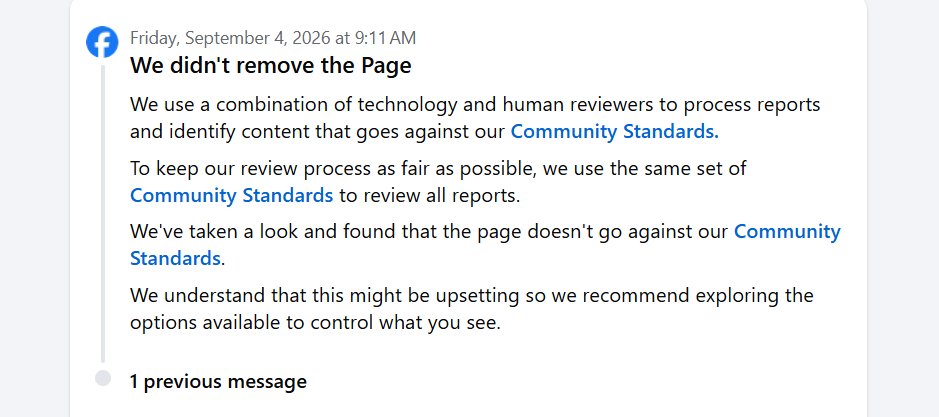
The six accounts that the company’s moderators left up had shared many heinous videos, including a toddler being struck in the face with a frying pan, a girl being beaten with a baseball bat, and a baby being kicked. (After a thoughtful internal discussion, we are opting not to share any of the videos at this time; if you are a member of the media considering follow-up coverage, please feel free to email us and we can provide examples to corroborate our reporting.)
If Meta were serious about proactively taking down the child abuse content, or detecting it at the time of upload, it would almost certainly be able to do so.
In fact, AI systems could probably be helpful: the company has invested hundreds of billions of dollars toward building “superintelligence” — reportedly making offers to top talent in the industry that have exceeded a billion dollars for a single hire — with Meta CEO Mark Zuckerberg saying last year that “whoever gets there first is going to have a long-term, durable advantage towards building one of the most important products in history.”
The tech to moderate these types of videos automatically already exists. In rudimentary testing, we found that Anthropic’s Claude AI was adept at evaluating whether videos contain imagery of violence against children.
For that matter, Meta appears to have already deployed systems that can identify the stomach-turning videos, even if it’s declining to use them to moderate content on its platforms. We identified the vast majority of the horrid accounts simply by loading one of them, and then scrolling Facebook’s recommendation feature, which eagerly provided a bottomless feed of similar appalling material.
In other words, Meta has extraordinary resources at its disposal to remove the child abuse videos, or to prevent them from being uploaded in the first place. But even when the material is flagged to it directly by journalists or reported by concerned users, it’s dragging its feet and refusing to delete it — a familiar pattern for a company that has long claimed to care about abuses of its platforms while doing little to stop them.
When we presented that line of thinking to Meta, the final abhorrent videos we’d flagged to the company’s press team finally disappeared from Facebook — though untold thousands remain on its platforms.
The company also provided a brief final statement.
“Not all the links you sent violate our policies,” it read. “Can you please avoid suggesting in your reporting that they do?”
Are you aware of anything about Meta’s moderation strategies that we know about? Reach out to tips@futurism.com. We can keep you anonymous.
More on Meta: Teen Boys Are Using Meta Glasses to Harass and Bully Girls at High Schools and Middle Schools