

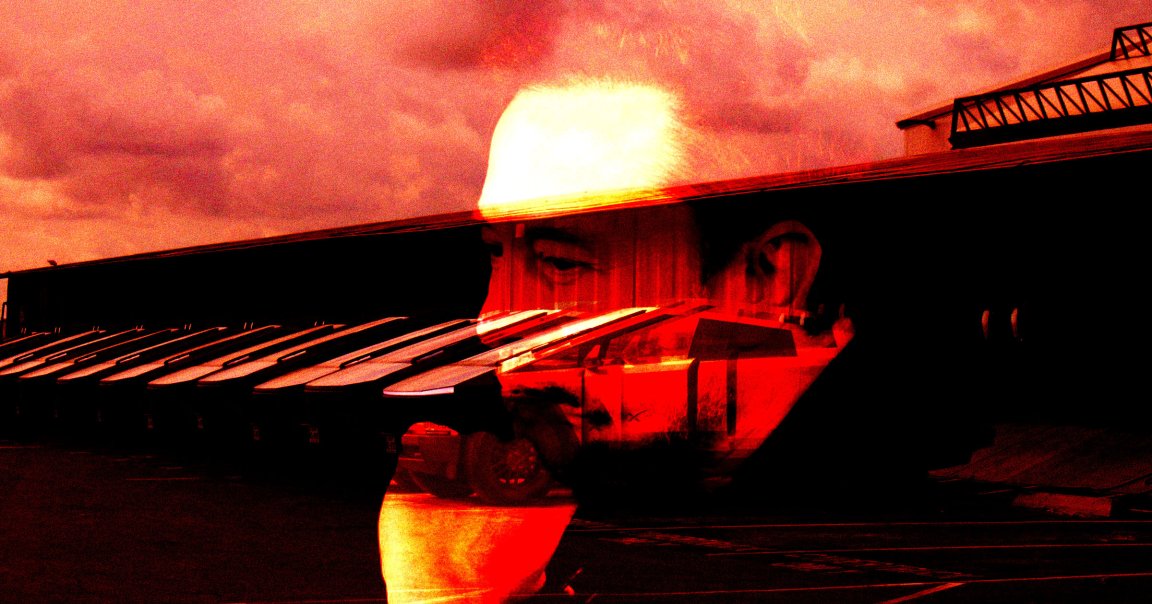
The Tesla Cybertruck is dead — and with it, whatever credibility Elon Musk had as a prognosticator of the future.
The angular, heterodox pickup represented the culmination of Musk’s eccentric brand of genius, at least to his legions of followers. It wasn’t supposed to just be an oddball soon-to-be curiosity like the DeLorean, but something that would transform the automotive industry.
That future did not come to pass. Last week, Musk announced on X that production of the truck would cease next summer, sending off this iconic symbol of himself with a single ignominious tweet.
Musk had previously mythologized his creation as a supposedly “apocalypse-proof” tank that could stop bullets, wade through water, and drive itself. Its stainless steel exterior and low poly design evoked a brash optimism of a future where aerodynamics, and perhaps practicality, were no longer a concern.
Most importantly, in the billionaire’s telling, it would sell in incredible numbers. Musk originally predicted that he would move up to 500,000 Cybertrucks every year, before setting a more realistic target — in relative terms, at least — of 250,000.
It says a lot that Musk actually put his money where his mouth was, pouring about $2 billion of Tesla funding into the Cybertruck’s development. Musk also built his Gigafactory Texas in part to manufacture hundreds of thousands of the brutalist pickups per year.
In the end, Tesla didn’t manage to sell its annual target at any point during the truck’s short-lived lifespan. In the three years it was being built, it sold around just 71,000 Cybertrucks total, estimates show. Experts say it could be the biggest flop in automotive history — even more disastrous than the notorious Ford Edsel.
Besides entering an already niche market — how many customers are there for a bizarre-looking electric pickup truck that costs around $100,000, depending on the model? — it didn’t help that a lot of what Musk promised about the truck didn’t turn out to be true. It wasn’t as cheap as the $40,000 price tag Musk originally set. It couldn’t double as a boat, as some drivers learned the hard way. And with 11 recalls under its belt for issues like its stainless steel body panels flying off and reports of it bricking after going through a car wash, it was far-from apocalypse proof. And somehow Musk, in his capital-A Abundance of wisdom, thought it would revolutionize the automotive industry.
Remember, this is the same guy promising to not just put data centers in space — something that many experts are skeptical is feasible — but do so in such quantities that it’d amount to building a “sentient sun,” in Musk’s own words. His Grok AI will unlock the “true nature of the universe.” His Starship megarocket will help “extend the light of consciousness to the stars” and “make life multiplanetary.” And of course, humans will be colonizing Mars any day now; two years ago he predicted the first humans would reach the Red Planet in four years. We have two more years to go.
In any case, Musk seems to be in denial that his brainchild was a failure, arguing in a Sunday tweet that his winding down of its production was “not a case of [the] Cybertruck being unprofitable.”
More on Elon Musk: Governor-Elect of Texas Announces Plans to Bring Elon Musk Under Control