

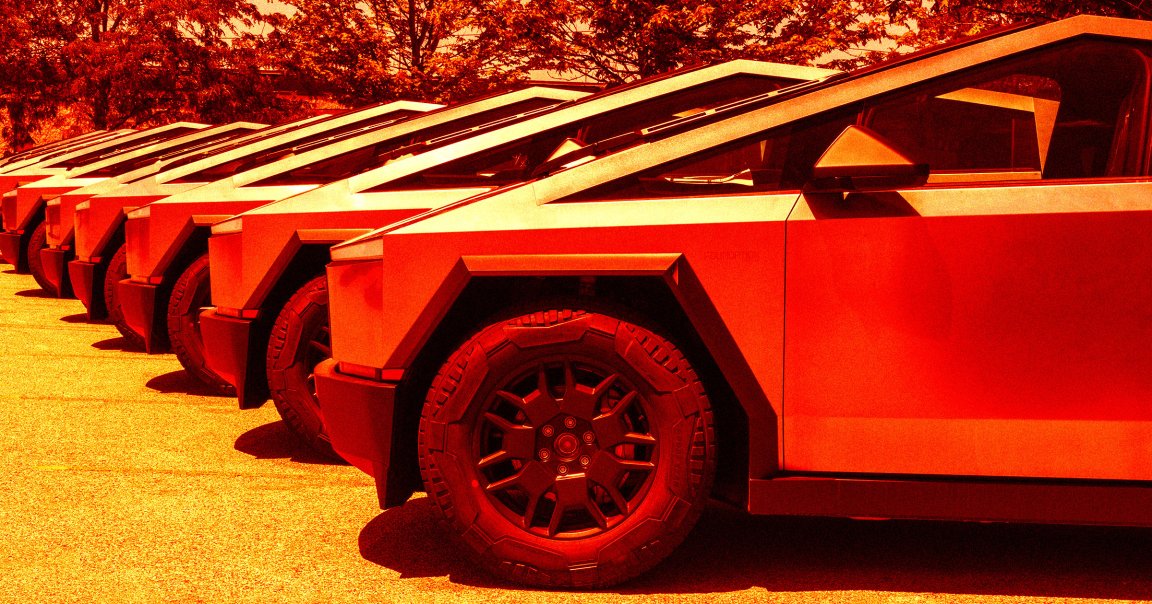
Hot off the heels of a devastating defeat in his attempts to influence the midterm elections, Tesla CEO Elon Musk announced that his EV maker would begin winding down production of its widely-reviled Cybertruck.
In a tweet last week, Musk said that the company was looking to “make room for increased Cybercab production” at its massive Gigafactory in Texas in the “middle of next year.”
Despite sales circling the drain for years now, Musk said that the number of orders for the pickup “far exceeds” the company’s capacity to build them — meaning, he claims, that Tesla has must “return deposits for a lot of people.”
The basic laws of economics dictate that Musk is fudging the details. If demand for the brutalist pickup was really that high, and the company was really able to produce enough for all of them, it would obviously be doing so instead of nixing the entire line. Put simply, the billionaire is almost certainly engaging in some tricky rhetoric to make it sound like buyers are lining up around the corner for one — which couldn’t be further from the truth.
Musk appears to be equating deposits with orders, which seems disingenuous at best, considering capacity to build them didn’t appear to be a problem when he sold $131 million worth of Cybertrucks to himself earlier this year. Countless deposits likely never converted into actual sales as potential buyers realized the sheer amount of problems the truck had.
In 2019, when the vehicle was first announced, Tesla claimed it had received 250,000 preorders. Considering the EV maker only ever delivered just over 70,000 of them — a far cry from the quarter million trucks a year Musk once promised — the number of people getting cold feet likely grew quickly in the four years it took for the company to get production going.
As of right now, we don’t know how many orders — if any — are outstanding and how many $100 deposits Tesla will have to issue refunds for. But it’s certainly a humiliating end to one of the biggest flops in automotive history.
Musk also refuted that the Cybertruck was “unprofitable,” but suggested that the “opportunity cost of the complexity of Cybertruck is vastly outweighed by the value of incremental Cybercab production.”
People on his social media platform didn’t buy the claim.
“LOL — no company shuts down a profitable product,” one user replied. “Just admit the Cybertruck has been one of the all time stinkers and move on. People might start to respect you a bit more.”
In reality, barely anybody actually wants to buy one of the trucks. The Cybertruck has quickly become a physical manifestation for all of the pent-up hatred directed at the almost-trillionaire. Beyond the truck becoming a major target for vandalism and open mockery, the vehicle has also been haunted by near-constant technical issues and has been recalled in the US a whopping eleven times over its short production run.
More on the Cybertruck: The Death of the Cybertruck Proves That Elon Musk Can’t Actually Predict the Future