

Flying cars are right around the corner, if Tesla CEO Elon Musk is to be believed.
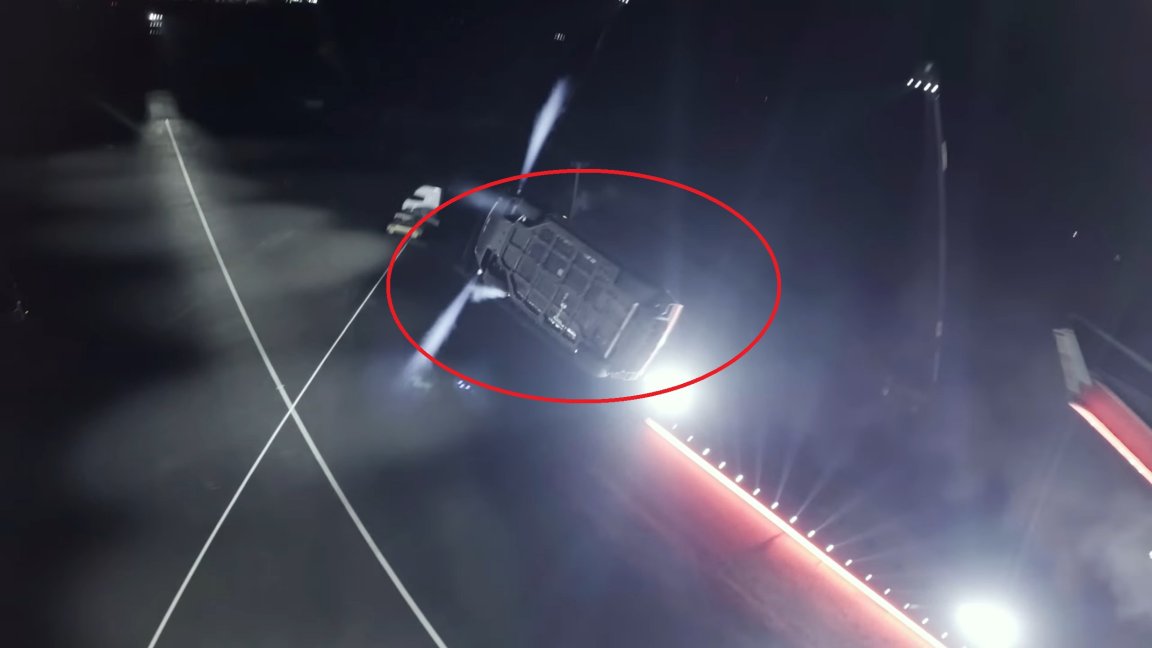
Last week, he unveiled the automaker’s long-awaited Roadster by having it drive to the top of a ramp, flipping upside down in the process, then fling itself into the air before using its cold-fuel thrusters to gently land in style. Minutes later, another Roadster did its best Evel-Knievel-with-a-jetpack impression by blowing itself into the air and leaping over a row of six Tesla vehicles, including its Semi Truck cab.
Sure, the Roadster can “fly.” There’s no denying that it was an impressive stunt. But huge questions remain, such as whether regulators will ever deem it road — let alone air — worthy. Another is if the cars used in the stunt will remotely resemble the actual product that’s sold to consumers, if such a thing does ever come to pass.
Tesla says the “Rocket” version of its Roadster is loaded with 600 liters of compressed air, 10 directional cold-gas thruster nozzles, and a huge suction-fan system on the bottom. To make room for it all, Tesla says it removed the passenger seat.
But some observers are wondering if the car is even more stripped down than that, perhaps even lacking a full-sized battery so the engineers could save room and cut down weight. Meanwhile, screenshots of the car’s sparse looking underside taken while it was midair seemed to show it lacking a suction fan, fueling further speculation that Tesla hasn’t figured out to fully combine its capabilities as they’re being presented. The car that stuck upside down to the top of the ramp and then cushioned its landing was, some skeptics allege, equipped with different hardware from the one that leaped into the air to leapfrog the other cars.
Practical questions abound. Without a full-sized battery, the car obviously wouldn’t be able to drive around on roads even if it were allowed to.
None other than computer scientist and “godfather” of AI Yann LeCun derided the Roadster’s aerial acrobatics display, calling it a “marketing stunt” and questioning its authenticity.
“Even assuming that 50 percent of the mass of the car is the compressed air, that gives you less than 10s of useful thrust (with thrust-to-weight ratio larger than 1.0). Probably more like 5 seconds, actually,” he wrote on X. “So the car must be an empty, lightweight shell containing big compressed air tanks. Cute demo, but totally impractical.”
A little bit of misleading showmanship certainly isn’t below Musk. Tesla stunned the world in 2016 with a promotional video of its self-driving car puttering along public roads and dutifully stopping for red lights. Musk boasted that it was clear evidence that “Tesla drives itself.” But later, its engineers admitted the whole thing was staged.
At its glitzy “We, Robot” event in 2024, Tesla tried to wow investors with its Optimus humanoid robots that poured drinks, danced on stage, and mingled with attendees while holding down a conversation. But it quickly became apparent that what Tesla had unleashed weren’t real-life C-3POs, because the seemingly autonomous robots were in reality individually teleoperated.
In any case, it’s impossible to verify what Musk’s showing off with the Roadster since Tesla isn’t allowing the public — journalists included — to take a peek under the hood.
More on Tesla: Tesla Bros Using AI to Dream Up Improbable Scenarios Where the Flying Tesla Roadster Would Be Helpful